Showing posts with label animal charity evaluators. Show all posts

12 November, 2022

SBF

I feel dismayed. Shocked. I feel so stupid.

I'm not sure why I trusted SBF. I guess you just naturally trust someone you've worked closely with. Someone who's donated significant funds that not only helped me directly, but several of my friends and fellow effective altruists.

Now, unless I'm severely mistaken, almost all the evidence I'm seeing points toward SBF having inappropriately used funds and then lying about it. He apparently stole not only the savings of thousands of innocent uninvolved people, but also tainted the very donations that I and several others have used over the years to do as much good as we possibly could. He's jeopardized the funding and lives of many effective altruists today, in many cases where people have already spent funds they were expecting but will now no longer get. He has destroyed the savings of anyone who foolishly held those savings in FTX or its related affiliates. Perhaps worst of all, he has tarnished the brand of effective altruism so incredibly badly that I honestly have to take stock and determine to what extent this reputational damage affects the fundraising work that I'm currently doing.

Sam had been a pillar in Effective Giving Quest's strategy. TSM FTX is a major esports team; FTX's purchase of Good Luck Games and subsequent holding of the Storybook Brawl world championships planned for this December had been planned to be a breakout position for EGQ. SBF's direct funding was going to allow EGQ to raise funds from game developers, streamers, and other gaming professionals without ever having to take a percentage to pay our own bills. Instead, we are now having to reevaluate our strategy and figure out how to move forward in a new environment where searching for "effective altruism" brings up fraud as the very first top story on Google and litters the first SERP from the fourth result onward.

I knew he spent his weirdness points in a weird way. I didn't think that mattered; I still don't. But other than that, I never caught on to him seriously being this dangerous. I didn't catch it for the years I worked at ACE, not even when we served on the board at the same time. I didn't catch it later when I looked into using FTX for my personal use. I didn't even catch it while I was prepping for calls with him about my new venture, Effective Giving Quest.

If it turns out that I'm wrong, that he's been unfairly characterized as doing fraud, then I'll later apologize for having said much of this. But the evidence I'm seeing now seems to indicate that fraud really did take place, and I just feel so monumentally tricked.

One of the only solaces I have comes from a short note from David Reinstein: 
"…[T]he sad fall of FTX makes motivating effective giving, outreach, and engagement more important…. Previously, a pushback against ‘motivating effective giving’  and making mainstream giving more effective was ~‘we have so much money already, and the core EA billionaires are much better aligned than the general population will ever be’. If that argument is valid, I think ‘it should work in both directions’ … so the corollary is ‘if we have fewer billionaires/less funds, the above should be more relevant’."

While I continue to feel badly, some relevant comments from Eliezer Yudkowsky, Peter Wildeford, & Kevin Cornbob remind me that maybe I'm not so much to blame as I currently feel:


Comment from Kevin_Cornbob on the EA Forum.

For reference, this is the awkward SBF I remember dealing with. He honestly did not strike me as the kind of person who would do what he apparently ended up doing, utilitarian or not.
@benthamite #crypto billionaire sbf ❤️s #effectivealtruism ♬ sonido original - Benthamite

EDIT ~12 hours later:
After thinking about it more, there were definitely more signs than I alluded to above. Nothing ever made me think: "this person will do something as serious as fraud", but there was at least one major instance where he took a serious action that felt rather wrong to me. I guess… I felt that it did not rise to the level of seriousness where this ever needed to be shared, or where I felt I should stop trusting him in other capacities. I suppose I felt that everyone makes mistakes, and just because this was what I might call a moral mistake, it maybe was made up for by his other actions and qualities. Maybe this kind of thing should have tipped me off. But it didn't. I still had moderate trust. Perhaps because I believe in assuming good faith, even in situations where it's difficult to see what that good faith might have been.

27 June, 2021

My Fortieth Birthday

I turn 40 in a few days.


I'm proud of all that I've accomplished so far in life. I believe that I've done exceptionally well in terms of my career. I've achieved success in my hobbies. I've made a few good close friends. My love life is excellent. I am confident in my personal application of ethics.


But, also I have experienced failure. I exercise occasionally, but not nearly as often as I should. I have family that loves me, but I don't see them as often as I'd prefer. I sleep way more than is ideal, due to my addiction to lucid dreaming. Perhaps my most difficult project is reliably performing everyday tasks, whether they're household or medical tasks.


Overall, I am happy. Turning 40 years old doesn't feel all that significant a marker, but it does make me think of a few specific things:


My best friend growing up, whose father died in his thirties. My friend told me confidently that he felt sure that he'd also die before 40, and so wanted to explore life well before then.


My late-twenties sister, who, a few years back, expressed amazement at my age. Not seeing her for a decade meant that changes we saw in each other occurred all at once.


One of the players on my esports team, who is not yet sixteen years old. Working so closely every week with someone so young is quite worthwhile, but the way they talk and the topics that come up do continually remind me of the age differential.


I guess that's why I'm writing up a blog post for my upcoming fortieth birthday. I want to remind myself of the good, and warn myself of the bad.


First, the good:


I'm extraordinarily proud of my career. The work I've done for effective altruism has been, I believe, quite invaluable. Helping to influence the creation of Animal Charity Evaluators and then heading communications there for its first two formative years was powerfully influential to the field of effective animal advocacy overall. Serving on the ACE Board today gives me immense pride. And, just this very week, I've applied to EA Funds for a grant to start a new organization, where I hope to create even more good -- potentially a huge amount.


I relish my hobbies. The recently created genre of rational fiction so far has so few entrants that I can reliably say that I've read every good text in the genre. When it comes to good television, I make it a point to experience as much of it as I can. My house is filled with the board games that I enjoy the most. I love that I live in the burgeoning era of video games, where I get to experience such creative and exciting stories created by the industry. I even get to feel that sense of camaraderie and success with the esports team that I captain.


My friends are few, but they are strong connections. The nonprofit I am starting is cofounded by one of my strongest friends. The esports team I play on has another of my best friends on it. I have several other friends in the various gaming communities I'm a part of, as well as many other friends who I have met in the polyamorous community.


Romance, for me, was a hard road, but I'm finally in a place that I am confident and comfortable with. I am polyamorous, asexual, heteroromantic, and sapioromantic, which makes for a strange combination. Thankfully, my lifelong partner supports me and does quite a bit to help me thrive.


When it comes to metaethics, I am a moral antirealist. Yet I want strongly for the world to be best that it can be, and I have a good understanding of what I would prefer that to consist of. I've dedicated my life to the field of effective altruism, and I feel that I've achieved a significant amount of good so far.


And the bad:


I live a mostly sedentary life. Exercise, for me, consists of walking around Little Seneca Creek, which I haven't done as much of during covid. I have intentions of being more active, but so far akrasia has made me unable to follow through on that.


Family, for me, has always been a failure point. Ever since the day my mother had police point a gun at me, I have been unwilling to ever see her again. I have hispanic and indigenous ancestry; the cop was white in the Deep South of Alabama. I am just not okay with the level of risk that my mother so callously put me through. My father's side of the family is much better, but for some reason I just am not that good at keeping as close contact with them as I should. I love my siblings; I want desperately to change my habits so I can spend more time with them. But, again: akrasia prevents me.


Sleep is the constant consonant note in my life. I have aphantasia in my waking life, but I dream lucidly with mental imagery. Before I knew what these terms even meant, I had no idea that others have mental imagery in their waking life, so, to me, it always struck me as strange that my dreams could be so very much more vivid than my waking life. I wasted so very much time prioritizing lucid dreaming over my real life. Today, I know better, but I'm still addicted to dreaming. I spend way more than I'd like to admit on sleep, far more than the 8 hours/day that most people spend.


Then there is the thing that I am worst at: everyday tasks. Doing dishes. Taking out the trash. Cleaning up rooms. Worst of all, because I've gone for my entire life without using or taking medication (minimizing even over-the-counter pain relief), the medical issues that started up in 2020 which have me now taking pills every day is causing a great deal of consternation. Remembering to take them seems like it should be an easy task, but instead it is a daily struggle.


Listing these out like this feels therapeutic. I have much to be happy about in the present -- and much for me to work on in the present. Overall, it is a good life that I lead.


But... I can't help but notice that I've focused only on the things in the present. There is no mention of my past, mostly because I have very little pride in my past. I started out life terribly. But, perhaps in part due to my aphantasia, I feel unconnected to those early decisions. I focus instead on the successes and low points of my life in the present. This is not a bad way to think about things, I think.


And so I feel good. Life is good. The flaws are things I can deal with. Once covid stops being such a concern, I can deal better with everyday tasks by hiring a cleaning service. Holding myself to a schedule should help with my sleep addiction. And the family thing will solve itself because, once my vaccination takes hold, I will be invited far more often to family events.


Later this week, I will turn 40 years old. And I am both happy and satisfied with where I am today and the trajectory I have for tomorrow.

27 December, 2020

Social Justice and Moral Uncertainty

[Note: This entry spoils portions of the most recent season of The Mandalorian, as well as the excellent rational story Metropolitan Man. Please only read this entry if you don't mind casual discussion of spoilers. I also spoil a few other pieces of fiction, but as most are over 100 years old, it's honestly your fault if you haven't read them by now.]

Well worth the read.
As I work through my understanding of representativeness, equity, and inclusiveness and how they should apply to my work, I find myself thinking back to Milton’s Paradise Lost, Ibsen’s A Doll’s House, & Wales’ Metropolitan Man. Lopsided power differentials make for poor relationships, even with full good intent. Satan’s argument that God is tyrannical despite his benevolence, purely because he has the final say is paralleled by Nora’s unease with Torvald and Luthor’s fear of Superman.

The power and fear you feel from Anakin in Rogue One is one-upped by Luke in The Mandalorian. It does not matter that Luke is a Light side user; his power is so overwhelming in that scene that his intent does not matter. No one should wield that level of power. Lex’s argument applies: he is just too dangerous to live in our world.

An unequal power dynamic.
These are all fiction, but it reminds me strongly of the power dynamics that exist within our culture of white supremacy. (I'm using the new definitions here, not the old ones that required a higher standard for deeming something white supremacist.) Social justice demands corrective action — the question, for me, is not to question its need, but to what extent should corrective action be prioritized. Satan abandoned paradise; Nora left her children; Lex committed murder. How far is it appropriate for us to go?

It is too easy to say that free open discussion norms trump the outright ban of certain topics. It is too convenient to claim that the needs of tortured animals are so immediate that they take priority over making the animal advocacy community a safe space for disadvantaged members. We can accomplish our goals of doing good without trampling on the needs of other communities. There is no need to take the position that Susan B. Anthony and Elizabeth Cady Stanton did when they opposed the fifteenth amendment. Frederick Douglass stood with them from the beginning, but was abandoned when the right to vote was being proposed for black men. I look back upon such decisions in disgust; why did the leaders of these causes break ranks so readily? Why could they not stand together? And then I think of the work that Animal Charity Evaluators is doing and wonder: to what degree are we justified in trampling over others' rights and needs?

ACE holds the position that corporate campaigns to help animal advocacy are good. They may or may not be effective at reducing the total amount of suffering undergone by farmed animals in industrial agriculture, but regardless they are considered as accomplishing good. Yet by working with a company like Burger King, praising it for introducing the Impossible Burger, for example (in 2001 PETA's campaign caused BK to release a veggie burger; then PETA targeted them again in 2006, showing that working with orgs like PETA to reduce bad publicity is a waste of time), we are trampling over the needs of the animals that Burger King kills. Is this justified? I want to say yes. I think that it is still good to endorse corporate campaigns because they reduce real suffering in expectation, even if other animals are tremendously harmed by the organization that we are working with and effectively praising.

Similarly, I recognize that there are black, indigenous, and people of the global majority (bipgm) that are actively harmed by some of the organizations that are doing effective animal advocacy work. They are not harmed nearly as much as the animals are in the previous example, but they are definitely harmed significantly. Is it justified to trample over their needs in order to effectively help the massive number of animals being tortured? I argued for 'yes' in the previous paragraph. Shouldn't I also argue for 'yes' in this one? The harms being incurred in the former paragraph are certainly higher than those being incurred in this one. And yet I find myself leaning toward 'no' instead. It doesn't feel justified to me, but I'm having trouble identifying why this is.

PCRM's reprehensible campaign.
When the Physicians Committee for Responsible Medicine ran a campaign aimed at convincing people to be vegan in 2012, they used fat shaming images in their videos and images. I was horrified. It bothered me that the PCRM was okay with using PETA-level tactics that actively hurt another disadvantaged group. When I learned that Ginny Messina, a member of their board, had spoken against it in their board meetings and been ignored, I lost all respect for the organization. (Messina resigned from their board over their insistence on (and lack of regret for) running this campaign.) I thought to myself: we can do animal advocacy work without actively harming other communities. We should aim to do good in all its forms, even if it sometimes reduces the effectiveness by which we can work on our core mission. This is especially true when our beliefs on which are the most effective interventions have low resilience. I remain convinced that running such ads is not only a bad idea, but that doing so is wrong, regardless of if the inclusion of fat shaming results in convincing more people to go vegan in the short term. I think this not just because I believe that in the long term we must be truthful for marketing and trust reasons, but also because I very, very, very strongly do not want to trample on the rights of fat people while doing the work of saving farmed animals.

Similarly, I want social justice for BIPGM while we work toward effective animal advocacy. I do not feel that it is justified to trample over fellow humans' rights while we do our work. So why am I seemingly okay with trampling over the other animals' rights while endorsing corporate campaigns? Am I being speciesist? Am I undervaluing the needs of the animals being harmed in the former paragraph? Or am I overvaluing the needs of the humans being harmed in the latter paragraph?

Moral Uncertainty
These are very difficult issues that I'm still working through. I'm not sure what is best. I find myself resorting to a Ord/Bostrom-style parliamentary vote of my inner credences and continually wishing that I had a better familiarity with updating on new evidence repeatedly. At subsequent moments, I keep thinking that each side's vote is getting more than its fair share through what seem to be rather one-sided deals — only to then think the same for the other side.

Currently, I just don't know what to think, other than to emphasize that figuring this out is a relatively high priority path for me to be on. And so I will continue to discuss these issues with others until we can come to an appropriate and justified solution.

14 November, 2019

Pay the Rent First

When you don't have much money, sometimes you have to prioritize which bills you can pay first. Should you pay the electricity bill? Or water? Food? Or rent?

If you're really desperate, then it can become a delicate balance of always staying ahead of eviction or the lights going out. But there's a narrow band of poverty where this is a legitimate question, where the answer always remains the same: Always pay the rent first.

If enough money comes in to pay bills eventually, but they don't come in quite enough time, then you always want to pay rent first because that's the most important thing to keep you okay. Other bills can be paid late, and you can get assistance at a food bank for meals, but not paying your rent can have devastating consequences.

Sometimes I think about charity this way. It can be nice to give to a direct charity like Animal Equality, giving you that warm feeling of knowing that your money is working directly on helping to make animals' lives better. But sometimes it's better to think about paying the rent first, before going to the movies or eating out.

Animal Charity Evaluators
Animal Charity Evaluators is an organization evaluator; it (among other things) looks at organizations that are potentially highly effective and looks into whether they actually are among the top tier of animal advocacy organizations using an effective altruism framework. ACE's job is to find and promote the best animal charities, so usually when people go to ACE's website, what they're looking for is a recommendation for which animal charity they should give to.

Yet before you give to those recommended charities, it may make sense to first give to the organization that is actually doing the work of finding and promoting the best charities and interventions that help animals. By paying the rent first (donating to ACE before donating to its recommended organizations), you can ensure that the best opportunities for giving in the animal advocacy space will continually be identified and the best charities will be incentivized to not just be among the best today, but to always move forward as well, to stay in that designation as an ACE top recommended charity.

This is why I'd like to ask those of you who are already planning to donate to an animal advocacy charity to donate a portion of that amount first to Animal Charity Evaluators. It's not as sexy as donating to direct aid organizations, but it's nevertheless important to pay the rent first.


I should mention a few caveats here.
  1. First, while moving donations can potentially be much more effective than merely increasing your donations, in the case I lay out here this is not true. If you're already giving to a top charity, moving it to ACE might or might not be more effective. My argument would follow effective altruism philosophy more clearly if I instead made the ask for people to increase their donation by giving to ACE, rather than moving money from one top charity to another. But others are already making asks like that; I'm trying to focus instead on the idea of paying rent before spending on movies, rather than spending solely on movies. This scenario doesn't have an analogue of increasing one's donations, so it doesn't apply here.
  2. Second, I'm on the board of directors for Animal Charity Evaluators, so that may color how you interpret my suggestion to give to ACE. I would argue that the reason why I'm on the board of ACE is because I believe it is so very highly effective and so sought it out; it's not the case that I'm only recommending ACE because I happen to be on its board.
  3. If you really took this argument to the extreme, you might want to extend the analogy to Maslow's hierarchy of needs, at which point you might argue that you need to first spend money on oneself before spending anything on charity. I'm not averse to these kinds of arguments, but I do think that saying so to the audience likely to read this blog post sends the wrong message. In general, people allocate far too little to the most effective causes, so arguing that we should spend on ourselves first isn't the best argument to be making, even if it technically is true.
  4. If you need more info before donating, I highly recommend that you read about ACE's room for more funding or my colleague Allison Smith's pitch for donations to the organization before the giving season starts, at which point all marketing efforts ACE makes will be made toward giving to its recommended organizations and funds.
  5. If you're single, it actually isn't that difficult to live without paying rent, so long as you pay for a gym that has showers and a post office box. In that case, you should probably pay for your gym membership and post office box first, before any other bills. I wouldn't recommend it, though.

18 April, 2019

A Kind of Degree

I've been thinking a lot recently about differences of kind versus differences of degree. Perhaps it has to do with a clicker game I've been playing recently, Mine Defense. In the game, you start off by clicking a mine, ostensibly mining gold from it with each click. As you progress, you gain options that allow you to click many times more efficiently, then ways to earn gold automatically over time, and ultimately to earn more of the ways that earn gold automatically over time, eventually reaching points of absurdity. Meanwhile, you also start to earn other types of income, and ways to earn those types more efficiently. (If you're looking for a clicker game recommendation, this is not it. It's not a particularly enjoyable genre, and this isn't the best of its kind. If you press me for a recommendation, I'd say to play Universal Paperclips (it relates to paperclip maximizers) but, really, I'd steer you toward other, more enjoyable genres.)

I've also been spending a lot of time around my siblings this week because Anh has come into town. I only see her relatively rarely, so I always end up interacting with them quite a bit while she's in town. (My siblings are 12, 15, & 25 years of age. I'm 37.) Being around children forces me to think in ways that are helpful for them to understand. I have to be able to process and talk in simpler language, and to break down concepts into their constituent parts. This process in turn helps me to clarify my understanding of things. (One of the best ways that you can force yourself to really learn a topic is to attempt to teach that topic to another person. It really brings into clarity the parts that were previously fuzzy to you.)

In one hand, I hold three apples. In another, I hold five. The contents of each hand are different, but they are differences of degree, not of kind. I could just modify the quantity of apples in one hand to get it to match the other, because the contents are of the same kind.

Compare this to a different situation. Now I have three apples in one hand, but five oranges in the other. This is a difference of kind, not degree, because no matter how I alter the contents of one hand numerically, I won't be able to make the contents of each hand match.

But not all such examples are obvious. In my work at Animal Charity Evaluators, I often had to contend with critics that thought that their methods of helping animals was fundamentally different from the methods that ACE recommended. They would claim that ACE is utilitarian, that you can't help a class of persons by promoting harm to them. Rape is wrong, they would say. Passing a law that forces rapists to bring a pillow with them to comfort their victims is an immoral strategy because the thing that is wrong is the rape itself; lessening the impact of the rape is inappropriate. Similarly, causing chickens to be tortured and killed is wrong. Passing laws that increase the amount of space they have to live in or that limit the ability of farmers to cut their beaks off is an immoral strategy, because you're then focusing on the wrong thing. Their argument is that there is a difference in kind, not degree, between what they are trying to do (outlaw harming of animals) and what we are trying to do (reduce the harm that animals suffer), and so it doesn't matter how effectively we achieve our goals, they're still insufficient for the goals they care about.

I think they are wrong. I think that, for all practical purposes, it is a difference of degree. I think that it matters how efficiently you go about these things. I think that you can get from where we are to a world where people are far more kind by traveling a road of reducing suffering at each step.

Think back to that example with apples in one hand and oranges in the other. Their building blocks are the same at some level. The molecules in each are different, perhaps, and maybe even the atoms, but the subatomic particles are basically identical. Rearrange them, change the quantity, and, all of a sudden, three apples become five oranges. At this level, the differences between them is of degree, not of kind.

My brother watches Naruto, an anime where all kinds of fantastical ninja have powers beyond belief. Some breathe fire; others control dirt. (I don't actually recommend it to anyone, but if you watch or read through it anyway, then you should definitely read the rational fiction fanfic The Waves Arisen, which requires knowledge of the series. If you insist on watching the anime, I recommend Naruto Kai, which removes the filler episodes.) In this world, one of the concepts used is a large golem strong enough to withstand a flurry of elements pushed against him. Imagine a tall golem of mud, with its feet planted to the ground as a torrential rain of water rushes horizontally against it, attempting to knock it down. The jounin behind this golem struggles to keep it upright. As parts of the golem's legs get pushed behind it from the water, he brings more mud to replace the front of the leg, in a never-ending cycle of renewal just to keep the golem standing.

At first, there seems to be a difference of kind between how we, as humans, stand in a light wind, and how this golem stands in his torrent of rain. But cells die; skin is renewed. When we stand in a breeze, this is what is happening in reality. Scent is the detection of molecules that drift from objects; humans have scent, too, and these are the parts of the body that drift from us, eroding naturally, but even faster from the wind that blasts our bodies. We are, in a very real sense, like that golem: renewing our body each moment as parts of us get constantly pushed away.

Consequentialism certainly seems different in kind from deontology. And it is, from a philosopher's point of view. But there are certain areas where the differences seem closer to a difference in degree, as strange as that may seem at first. I'm still thinking through how to make this argument, but the basic idea involves a non-philosopher deontologist thinking that harm is bad, and yet still preferring a choice that results in less harm than in a choice with more harm. Numbers matter, even for deontologists. Maybe to the point where moral choices converge when using real world data? More on this later.

25 February, 2019

My History and Future with ACE

I've been a close advocate of Animal Charity Evaluators from the very beginning. When the effective altruism movement was still quite young, I participated regularly in forums about there not being an official animal advocacy arm of EA, and how the animal cause deserved to be a significant pillar of the EA movement. I wasn't the loudest voice, and I certainly wasn't the most persuasive, but I gave my support and attention, hoping to see animals represented more heavily by EAs.

At the time, I was working in a non-EA charity helping to fight domestic childhood hunger. I had been a vegetarian for several years at that point, but had never before volunteered or participated in any type of animal advocacy space. In fact, I regularly worked closely with employees at large animal meat companies like Tyson Foods, as a part of my job to get food to hungry children. I was not a fan of many fat-shaming pro-vegan ads put up by organizations like PETA or PCRM, and didn't think much of the low efficacy of local shelters. My opinion of the general animal advocacy movement was quite low. My philosophical stance was quite clear: the systematic torture of pain-capable beings was not justified -- yet I didn't really have anything more than vaguely positive feelings toward any specific animal advocacy organizations.

When 80,000 Hours started Effective Animal Activism as a spin-off project, I was among the first people to sign up as a member. Mostly my contributions back then were limited to facebook posts and working through arguments via email. Eventually, I spoke with Rob Wiblin to learn how I could do more. Within a few months, EAA hired its first Executive Director, Jon Bockman, and I met with him on his very first day, successfully angling to become his first hire.

I served as the Director of Communications for the first two years at ACE. Later, I scaled back to part-time, so I could do earning-to-give in a second job. Overall, I worked as Data Scientist for over two additional years. My last day was at the end of last year.

Today, I accepted a position on the Board of Directors at Animal Charity Evaluators.

I'm glad to know that I can continue to add my skills and experience to help direct an organization with which I so strongly personally identify. I truly want to make the most of this opportunity to help make Animal Charity Evaluators as strong as I'm able.

13 June, 2018

Effective Advertising and Animal Charity Evaluators

This entry was originally posted on Effective-Altruism.com. It is reposted here for reference only.

[Summary: Animal Charity Evaluators wants to address feedback that we've heard from the effective altruism community regarding our online marketing practices. Although we follow best practices in the advertising industry, some EAs feel that we sometimes use advertising which glosses over details and is potentially misleading to the public. As the communications data scientist for ACE, I explain why we feel these advertising practices are not only net beneficial to the EA community, but also should not be considered to be misleading.]
Our mission at ACE is to find and promote the most effective ways to help animals. One of the ways in which the promotion part of our mission is fulfilled most effectively is through reaching those who are most passionate about helping animals but who have not yet been introduced to the concept of effective altruism.
While some of our ads are aimed at existing EAs, the majority of our advertising efforts focus on the above audience for three reasons: (1) the large scale of this audience compared with the size of the EA audience, (2) our belief that they have the most potential for change once they learn about effective animal advocacy (EAA), and (3) the fact that their counterfactual donations seem likely to be less impactful than those of EAs.
We have received some feedback on a few of these marketing practices—specifically, we have received feedback suggesting that we might not be advertising in a way that the EA community would most like to see. I will go over a few such examples before sharing why we use our current methods of advertising.

Double Donations

In late 2017, we held a donation-matching campaign. A generous donor offered to match any donations we received to the ACE Recommended Charity Fund. This Fund is not used for ACE operations; the entirety of this Fund goes toward our recommended charities. (We now have a checkbox indicating that users may choose to donate 10% of their gift directly to ACE, but at the time we had already reached our funding cap for the year and were not accepting new donations.)
We know that the EA community is generally not in favor of donation-matching campaigns. There are four main reasons why this is so:
  1. Most donation-matching campaigns are illusory
  2. Non-illusory campaigns may do harm via double-counting
  3. Matching campaigns encourage dishonesty
  4. There may be better ways for large donors to leverage their money

Most donation-matching campaigns are illusory

At ACE, we are careful to ensure that any matching campaigns are entirely non-illusory. GiveWell has pointed out several problems with illusory matching campaigns. We agree with their reasoning. For example, last year a donor approached us asking about doing a matching campaign to benefit ACE; we declined it because their donation was going to happen whether we set up a campaign or not.
However, not all matching campaigns are illusory. For our year-end donation-matching campaign in 2017, we had a donor who would not otherwise have given to our Recommended Charity Fund but who was interested in doing a donation-matching campaign with us. We discussed how a non-illusory campaign might very likely reach a broader audience, inspiring hundreds of new people to participate in effective giving for the first time. We believe this type of influence matching is especially effective with non-EAs. However, as Karnofsky points out, it may be better for existing EAs to ignore the influence matching aspect when making decisions on where to donate—even if we prefer non-EAs to be influenced by them.
ACE’s commitment to non-illusory matching campaigns alleviates the concern raised by Jeff Kaufman about counterfactual trust and contradicts the assumptions made by most polled EAs on Facebook. Sometimes even illusory donation-matching campaigns can be beneficial (as Avi Norowitz points out with the Facebook #GivingTuesday retrospective) but this requires special circumstances.
We are careful to explicitly note our position on these influence-matching campaigns in our FAQ, and we believe that using them has been a net positive for our non-EA audience.

Non-illusory campaigns may cause harm via double-counting.

Ben Hoffman has rightfully pointed out that overassignment of credit can obscure opportunity costs with donation-matching campaigns. Given two rational EA actors, believing that each is causing the other to donate may result in a scenario where each is giving less optimally than they’d otherwise choose. However, this example only causes harm if both sides are changing their mind on where to donate due to the existence of the donation match.
At ACE, we only accept matching campaigns where this does not occur. While we don’t have full certainty of their counterfactual actions, we believe our matching donor not only would likely have counterfactually given a smaller amount elsewhere had we not done the campaign (thus making our campaign non-illusory), but also that they would have counterfactually funded a different non-EAA donation-matching campaign. This ensures that, at most, only one side is influenced by the matching campaign—and so evades the situation Hoffman describes where double-counting causes harm.¹

Matching campaigns encourage dishonesty

Overassigning credit isn’t the only way that matching campaign incentives reward dishonesty. In 2016 Benjamin Todd reported that 80,000 Hours had previously run partially counterfactually valid donation matching campaigns, by allowing the donor to commit to delaying funding rather than ensuring that the funding is completely counterfactually valid. Ben Kuhn ran a survey that found that most donors expect matching campaigns to be entirely counterfactually valid, so this remains an issue.
At ACE, we’ve tried to maintain a balance of being intellectually honest and using copywriting that isn’t overly wordy. During our year-end donation-matching campaign, we initially used advertisements that contained the phrase “Double Your Impact”, but then switched to “Double Your Donation” after receiving feedback about where that balance made the most sense.²
We believe using “Double Your Donation” as an advertisement headline strikes that balance well. It is an appropriate shorthand for what is actually occuring: the amount of money that would go to this fund was indeed doubled, and, had the donation match not occurred, our matching donor may have given to a different non-EA cause.
As further evidence that these are real counterfactual matches where influenced donations are legitimately doubled, in 2016 and 2017 we surpassed the agreement of what the donor had originally offered to match, after which the donor followed up by continuing the match through these additional donations to more than double what they originally offered toward the matching challenge.

There may be better ways for large donors to leverage their money

Ben Kuhn performed a survey of research on the effectiveness of matching campaigns, concluding that matching campaign effects are generally smaller than we might at first expect, and suggesting that there are more effective ways for large donors to leverage their money. We have no reason to doubt the validity of his analysis, though we do have limited conflicting anecdotal data from our matching campaigns.
When we are approached by large donors, we generally try to steer them away from the donation-matching campaigns they are ordinarily used to, advising them to fund general unrestricted programs and administration instead. However, last year we set a funding cap for our own operations; once met, there are only so many other ways that large donors can leverage their money. When a legitimate influence-matching campaign opportunity arises, we don’t think it is inappropriate to take advantage of it at the 1:1 rate, even if the returns may not be as much as you might expect.
Anecdotally, we’ve found that our matching campaigns have brought in a disproportionately large number of new donors—the majority of whom were not previously involved with effective giving. While we did not set up a control group, we can report that 73% of the donors to our 2017 matching campaign were first-time donors with ACE, and our post-donation survey showed that over 80% of respondents reported being motivated to give specifically due to the matching opportunity. In addition to the hundreds of thousands of dollars raised by this new audience,³ we were able to teach them about effective animal advocacy and to support them in effective giving elsewhere in the EA movement. The amount that these donors will give to effective charities during their lifetime is significantly higher than the donation-matching campaign that attracted them; we continue to build relationships with these new donors. So while we concur with Kuhn that the raw donation amounts might not be as influenced by a donation match as we may at first think, in our case the flow-through effects seem to more than make up for this difference.

Utilons Versus Fuzzies

Another advertising example that has received some limited criticism from the EA community is our tendency to use cute pictures of animals and catchy messaging in many of our ads. We’ve heard this critique several times in person at EA conferences, although it’s rare to see the argument explicitly laid out online. The idea is that advertising in a way that tugs at people’s fuzzies may be appropriate for direct-level EAA organizations such as The Humane League, but that a meta-charity like ACE should focus solely on arguments for maximizing utility. By posting cute pictures or clever one-liners, we may be misrepresenting the type of work we do. After all, GiveWell’s Facebook feed rarely uses pictures other than to show graphs or their logo; and MIRI’s feed focuses on showcasing data, not cute pictures.
We feel that these lines of argumentation misunderstand the role that ACE plays in the EA movement. Yes, we have a core audience of EAs who use our charity recommendations—and yes, those recommendations are based on what we find to be most effective. We fully identify as an effective altruist organization. However, a large portion of our intended audience is comprised of animal lovers who are not yet aware of EA principles. We strongly believe that this is the audience that is capable of making the largest positive change once they learn about effective animal advocacy. Catching their attention via cute animal pictures is the best way we’ve found so far to get them to read more about why effectiveness is important.
We have data to support this. We’ve experimented with pushing out various types of Facebook posts to both our current audience (to increase engagement) and to potential new followers. Although we make a point to post a combination of EA-oriented messaging alongside posts that showcase cute animals, the only posts that receive traction significant enough to generate engagement and reach a larger audience are the ones that use fuzzies, not utilons, as the main hook.
Facebook in particular has a positive feedback loop where the posts which garner the most reactions and engagement tend to be shown to more followers, whereas the lower-performing posts only get shown to a subset of our Facebook audience. This results in the average Facebook user getting the impression that the majority of our posts are fuzzies-centric on trending topics, when in reality a considerable amount of our posts are utility-centric on data-oriented news.
This feedback loop works to our advantage. Over time, the best performing posts reach non-EA audiences who are likely to be sympathetic to the cause of effective animal advocacy. This allows our brand to grow consistently, introducing new people to the ideas of the EA movement.

Graph Accuracy and Completeness

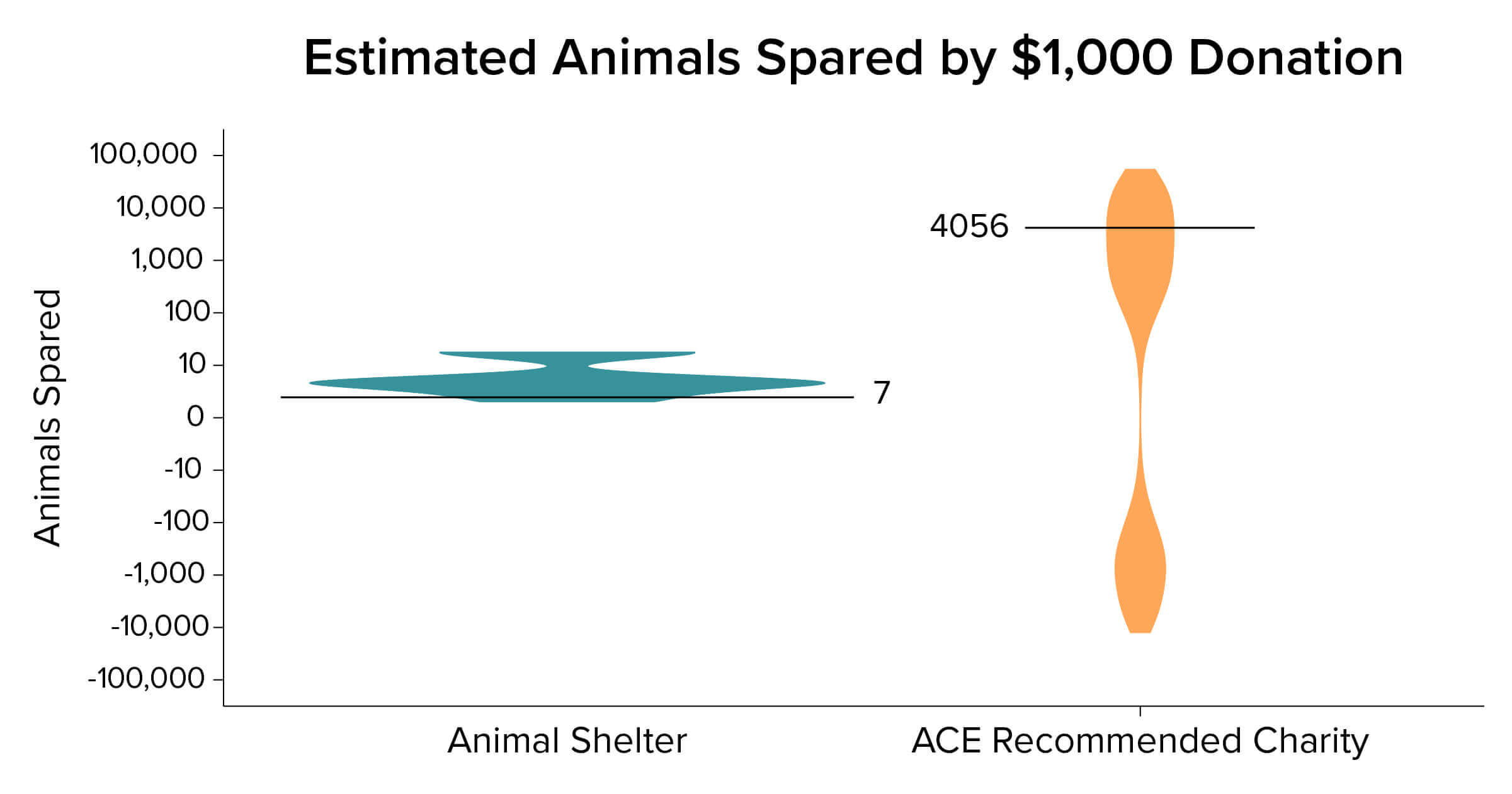
We’re currently in the process of improving some of our graphs in order to make them more easily shareable. For example, our donation impact page includes a violin plot that shows how many animals we estimate are spared by a $1,000 donation. While the data is accurate, the resulting graph is very difficult to interpret—and is therefore not ideal for sharing at animal rights conferences or on social or journalistic media. The amount of time it takes to explain probability density to passersby at non-EA conferences or to general online audiences looking for a quick picture that explains ACE’s thoughts usually exceeds their (understandably limited) attention span. If we want to reach these audiences, we need to produce graphs that illustrate the point much more efficiently.
However, sharing just the average estimates (seven animals spared for shelters and 4,056 for ACE recommended charities) could be seen as deceitful, as it doesn’t take into account the uncertainty involved in making these calculations. Clearly, there is some compromise between a full violin plot and sharing just the mean as the best single estimate for each category. We are still working out where that balance lies.
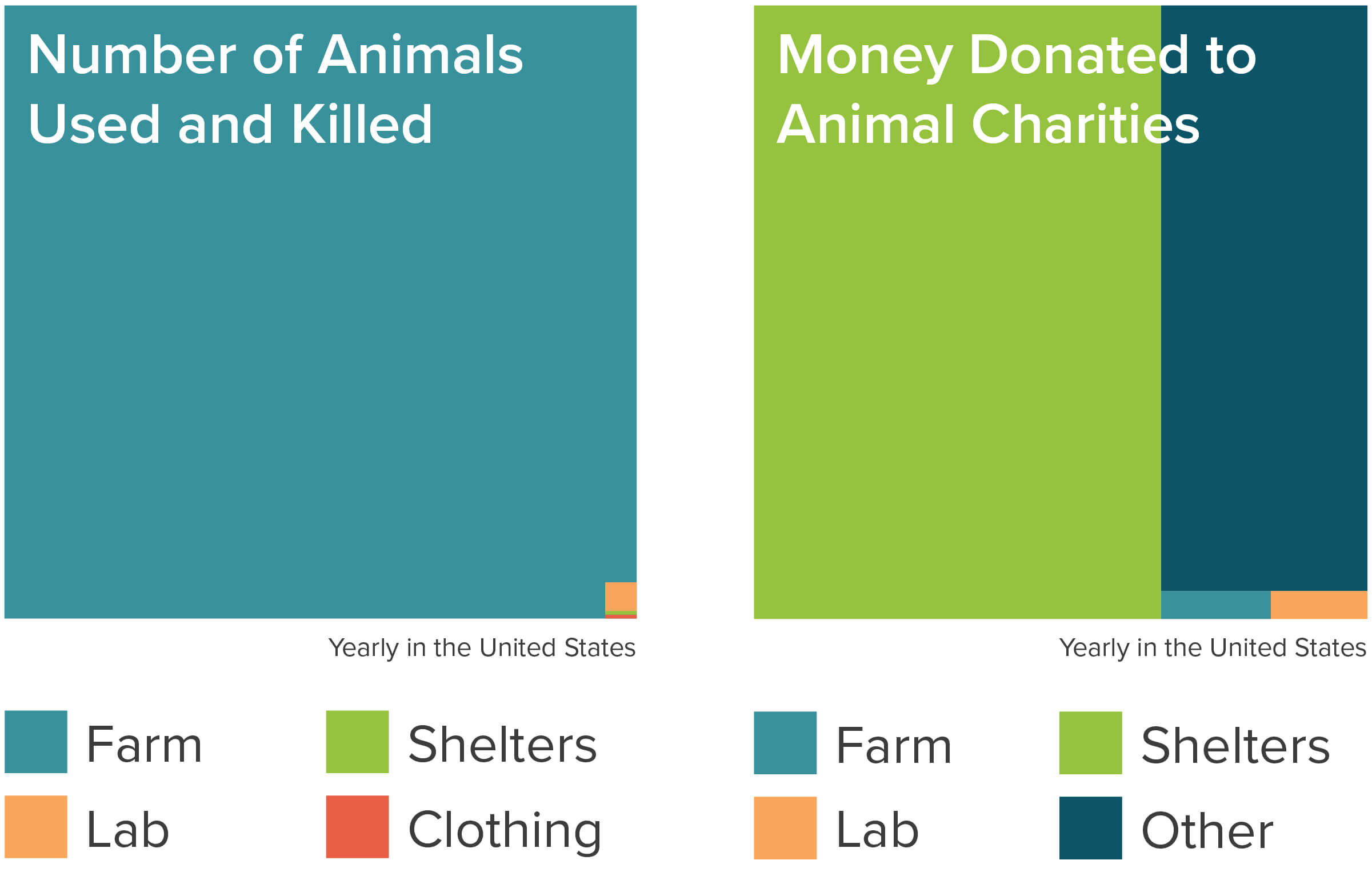
A similar issue comes up with our donation allocation chart. The data on the left omits wild fishes, who receive almost no portion of animal charity donations. The data on the left also includes animals used for clothing, but the data on the right replaces that category with “mixed or other activities.” On the page, we explicitly point out how the “mixed or other” category was put together, giving an example of guide dog training as one component. This matters because some advocates may consider subcategories like guide dog training as a primarily human-centric charity, not an animal charity, and this might affect the relative size of the chart regions. However, when this chart does gets shared online, it’s generally just the image portion that people will copy and paste. Although these shared images will not include the surrounding text, we believe it is sufficient to include the extra information on our website. We feel similarly with regard to the analogous donation impact chart; including the probability densities as additional information on our site is sufficient, so long as the chart itself includes ranges for our cost-effectiveness estimates.

Marketing Best Practices

The above marketing practices are specific to EA organizations. Most non-EA organizations do not object to setting up illusory donation-matching campaigns, nor reaching out based on fuzzies, nor ensuring that graphics are as accurate as possible. We care about these issues because we are committed to the norm of being extraordinarily honest. As Ben Hoffman rightly points out, “When the activity of extracting money from donors is abstracted away from…other core activities of an organization…, best practices tend towards distorting the truth.”
This doesn’t mean we should shy away from all nonprofit marketing best practices. To the extent that we can reach out to new audiences, increase the number of donors who are giving effectively, and grow our brand without compromising what we believe in, we feel that using best practices is both acceptable and desirable.
One of our goals is to continually be better able to introduce non-EA animal advocates to effective animal advocacy ideas. We accomplish this through several methods:
  • We try to speak in language that non-EA animal advocates already understand when in an appropriate context. This not only means using cute pictures in social media posts, but also talking about projects and interventions that may not be a currently understood top intervention, so long as it reasonably could apply.
  • We use multivariate testing on social media adverts and email campaigns, but we are careful to only test messaging that matches our brand and to only use subject lines that accurately convey the content of each email.
  • We segment our audience, showing different information to different audiences, while being careful not to cut information sent to various audiences in a way that might be seen as deceitful. Specifically, we take care to only show different content based on the different interests of our audience; we do not alter the meaning behind our messages when segmenting our audience.
  • We use a Google ad grant and SEO efforts to gain traffic from audiences not yet familiar with effective animal advocacy, without deceiving visitors as to what they will see once they visit.
  • We track key performance indicators to judge how effective our communications strategies perform, but are careful not to focus on quantity at the expense of quality.
  • We create videos that appeal to a general audience through fuzzies in addition to posting videos of webinars and symposium talks.
  • We take advantage of opportunities to direct more funding to effective animal charities, such as running a non-illusory matching campaign that is very likely to inspire new people to give effectively.
While we are careful not to blindly follow marketing best practices, we nevertheless utilize them when they don’t interfere with our values. We prize integrity and take care to exhibit norms of honesty when following accepted marketing principles. We do not use “rhetorical tricks” nor “sales techniques” to convince others; our use of imagery is solely used to gain attention. Arguments for EAA on our site are fully transparent, and we both accept and encourage feedback on the research we perform.
I’m proud to report that we are continuing to grow our brand, increase the number of donors who are giving effectively, and introduce new audiences to effective animal advocacy. In December last year, we raised over $1.26 million for our Recommended Charity Fund—a significant portion of which came from extremely generous first-time donors not already identifying themselves as EAs. Of course, we couldn’t achieve these results for our recommended charities without the support of EAs, who so generously helped to fully fund ACE directly last year, but the larger point is that these strategies are encouraging non-EAAs to donate to more effective causes and are making a subset more aware of effective altruism in general.
If you work with an EA organization, we would love to hear about the marketing/communications techniques and/or successes that you’ve had when promoting EA organizations. We’d also like to hear if anyone has any concerns about ACE or any other EA charity using these kinds of marketing techniques. Are you comfortable with ACE’s methods of using donation-matching campaigns? Do you agree that marketing with fuzzies is acceptable even for a charity evaluator like ACE? What’s the minimal amount of information our shareable images should convey? Do you feel that the way ACE follows nonprofit marketing best practices is appropriate?
We look forward to hearing your thoughts.

¹ This donor decided to give to our Recommended Charity Fund on the basis of our recommendation, not by calculating the additional effects of the matching campaign, because they counterfactually would have done a different donation-matching campaign anyway. This means that while an overassignment of credit may have occurred, this overassignment did not change how the donor would have counterfactually acted. 
² In November 2017 we initially used the phrase “This means that you can double the impact of your donation from now through the end of the year by donating to our Recommended Charity Fund” in at least one marketing material, but after receiving feedback from both ACE staff members and outside EAs (including Remmelt Ellen and Marianne van der Werf—thank you to both!) we standardized to the “double your donation” language instead across all marketing materials.
In previous years we were less strict about our language, using “Double Your Impact” in several advertisements during the 2015 and 2016 giving seasons. We did not make this choice blindly; at the time, we felt that “double your impact” and “double your donation” were different mostly in what kinds of audiences they attract, and that this overrode any concerns about one being more strictly accurate than the other. “Double your impact” emphasizes the effect of helping others, whereas “double your donation” emphasizes what one can personally accomplish.
Note that these terms are regularly used interchangeably in fundraising campaigns outside the EA community, and we then felt that most people wouldn’t take campaign headlines literally. In 2017, we updated to believing that it was not enough for our FAQ to describe our commitment to non-illusory matching campaigns, and we standardized to only use “double your donation” language going forward. 
³ New donors made up 56% of the pre-matched amount raised during our 2017 matching campaign. 
⁴ This positive feedback loop means that the majority of our Facebook post views are of fuzzy-style content. However, this is only true for posts that get pushed out to users; for those who actively come to the ACE Facebook page for content, the ratio of fuzzy-style to utilon-style is roughly one-to-one. 
⁵ This is also explicitly why we do not publish cost-per-animal-spared numbers in the same way that you may see for QALYs or DALYs elsewhere. 
⁶ We acknowledge that there are limitations to this chart and are working on an updated version that will include both data on wild animal suffering and more clear proportions that indicate how limited animal charity donations are overall. 
⁷ ACE has publicly endorsed and acts in accordance with CEA’s guiding principles of effective altruism. 
⁸ In total, we influenced over $6 million to our recommended charities in 2017, including the $1.26 million that flowed through our Recommended Charity Fund. 
⁹ We are currently working on creating several more charts for non-EAs that are more shareable, and we would especially appreciate any remarks that express what level of simplification the EA community would be comfortable with. 

15 March, 2018

Animal Charity Evaluators Introduces the Recommended Charity Quiz

This entry was originally posted on Effective-Altruism.com. It is reposted here for reference only.


The following post was published on the Animal Charity Evaluators blog earlier this month. We've just released a new recommended charity quiz that allows users to enter in their specific preferences and outputs the best animal charities that correspond to those values. We believe that this is especially appropriate for effective animal advocacy charities, as there may be a higher level of variance depending on initial values than there would be with human-based charity comparisons.
When it comes to reaching out to non-EA audiences, we believe that using quizzes like this may allow us to connect more closely with existing animal advocates who are as-yet unfamiliar with EA ideas like focusing on just the "best" charity. We also want to be wary of relying too closely on expected value calculations, since the cost effectiveness estimates we use are approximations, fail to resolve uncertainty, and are subject to bias, even though we do think they are useful for intervention reports and charity evaluations. For these reasons, we believe that this new recommended charity quiz is both appropriate and useful.
The remainder of this post is copied verbatim from the ACE blog, authored by ACE Research Associate Jamie Spurgeon.

We are excited to announce the launch of our recommended charity quiz. This quiz will allow you to discover charities that match your interests and values, determined by some of the distinguishing features of our recommended charities.
At ACE we are always looking for new ways to engage with our community and help donors connect with the most effective charities. To this end, we recently released an update to our charity comparison chart and now you can use the quiz to receive a personalized recommendation of the three charities that best align with your goals and interests. While we think that reading our reviews is the best way to fully understand why we recommend our Top and Standout Charities, we recognize that reading all of our reviews may take more time than some readers have to invest. The charity quiz can help you to quickly identify charities that you may be particularly interested in, giving you more time to explore those organizations in depth.
The following information is for those more interested in further explanations of the factors explored in the quiz. In general, the quiz aims to capture individual preferences about charity features that aren’t clearly good or bad. By measuring the relative importance individuals place on each of these features, we can identify charities that closely align with those preferences.

How important is a strong track record of success?

This factor is directly related to Criterion 4 in our comprehensive charity review process. Among the charities we evaluate, there is a large disparity in the strength of their track records, and this is an important consideration for some donors. A charity’s track record encompasses at least three factors: (i) the length of time that the charity has been achieving successes, (ii) the number of successes they’ve achieved, and (iii) the magnitude of effect those successes have had in creating change for animals.
The quiz question aims to determine how important the overall effect of these factors are to you, relative to the other traits that make for a promising charity. If you are a potential donor, charities with strong track records may seem to be a safer option as they appear more likely to achieve future successes similar to those seen in the past. However, some donors may not feel that track record is necessarily a strong indicator of future success, or they may simply prefer to support younger charities that could be working in a particularly promising area in which it is possible they will have an even larger impact if successful.

Do you prefer to support more established advocacy methods with a lower risk of failure, or would you like to support advocacy that is less established but may have a potentially larger impact?

There are other aspects of charities’ work beyond track record that affect the balance between risk (the chance of future success), and reward (the magnitude of that success). If we recommend a charity that we perceive to be higher risk, then it is often because we feel their potential reward is higher, so these two individual factors tend to remain relatively in balance across all of our charities.
For example, a charity working in regions where the animal advocacy movement is less developed, such as parts of South America, may be considered higher risk but also higher reward. They may find several advantages to their work:
  • Wages may be lower, allowing them to achieve more with their budget
  • Proven methods from countries with more established animal advocacy movements can be re-used (e.g., using corporate outreach campaigns to secure cage-free commitments for egg laying hens)
  • Interventions such as investigations may have a higher impact, as they are less saturated in number1
However, there are unknown factors involved with work in some South American countries that may make it less tractable than it initially appears:
  • The public attitudes towards vegan advocacy may be less favorable, or other unknown cultural differences may affect individuals’ receptivity to advocacy messaging
  • The different legal situation may prohibit the success of some interventions (such as investigations and corporate outreach)
  • The political climate may affect the likelihood that legal advocacy work will be successful
Other examples of charities that might be considered higher risk/higher reward include charities that work on longer-term goals and those that are focusing efforts on highly neglected groups of animals (such as fish). This quiz question aims to capture each donor’s preference for higher vs lower risk/reward.

Do you prefer to donate to charities with smaller budgets, or larger budgets?

During our charity evaluations, we have two main criteria in which we consider a charity’s budget—Criterion 1, which concerns the amount of room for more funding that a charity has, and Criterion 3, which concerns the cost effectiveness of the charity’s programs. As it is objectively better for a charity to have both a higher room for more funding and a higher cost effectiveness, these are not especially useful metrics for determining a preference that our audience may have. However, the absolute size of a charity’s budget often comes with advantages and disadvantages, and the charities we recommend span a large range in this regard. For example, donations to smaller charities will have a greater effect on that charity than a similar donation to a charity with a much larger budget. Additionally, smaller charities are more likely to be working in novel areas. On the other hand, charities that have a larger budget may be able to achieve things that smaller charities can’t, such as influencing large food producers in a corporate outreach campaign.

How important is it for a charity’s work to support the animal advocacy movement as a whole?

While most of our recommended charities work to directly cause change for animals, there are some that also (or sometimes solely) work to support the movement as a whole. This includes conducting and publishing research, either in collaboration with other charities or through evaluating their own programs. It also includes charities that take on a more organizational role, providing support to and helping coordinate the efforts of other charities in order to create a greater impact. Charities that are not as supportive of the movement, however, may be less so because they are working in particularly niche or neglected areas, and this may be of particular interest to some donors. Some donors may also simply prefer to support charities that work more directly to create change for animals.

Which types of animal advocacy do you want to support?

To measure donors’ preferences for particular interventions, we have divided up the types of animal advocacy interventions into three main groups: traditional advocacy, institutional advocacy, and innovative advocacy.2 Traditional advocacy includes interventions that have been commonly used by the movement for more than 10 years and often aim to create individual changes in attitudes or behavior—such as the adoption of veganism. These interventions include leafleting, protesting, and undercover investigations, among many others. Institutional advocacy includes any interventions that target institutions—from large international corporate food producers to smaller institutions such as schools and hospitals. Finally, innovative advocacy encompasses more novel areas of advocacy—including the development of cultured and plant-based meat, securing legal rights for animals, and conducting or facilitating research into wild animal suffering. These tend to be more ambitious approaches that have large potential for change, but that also have more uncertainty surrounding whether their end goals will be achieved.

Putting it all together

We have given each of our recommended charities featured in the quiz a subjective score for each topic that is covered by a question or a particular response. As you go through and specify your preferences, the quiz uses your responses to weight the scores given to each charity. It then recommends the three charities that most closely align with the preferences you indicated. Expressing a strong preference for a particular question puts a higher weight on that factor when calculating your matches.
If you have any further questions, please leave a comment here or submit a feedback form at the end of the quiz. Don’t forget to share your results!

  1. We expect that the U.S. is reaching a point where the large number of investigations released means that future investigations are likely to start to have diminishing returns. 
  2. It’s difficult to divide interventions into distinct categories, as often those categories will overlap. For example, while protesting and undercover investigations are examples of established advocacy interventions, they are both also used to support institutional campaigns. However, as multiple answers can be selected for this question, we hope this won’t significantly skew our quiz results.