Showing posts with label published-elsewhere. Show all posts

13 June, 2018

Effective Advertising and Animal Charity Evaluators

This entry was originally posted on Effective-Altruism.com. It is reposted here for reference only.

[Summary: Animal Charity Evaluators wants to address feedback that we've heard from the effective altruism community regarding our online marketing practices. Although we follow best practices in the advertising industry, some EAs feel that we sometimes use advertising which glosses over details and is potentially misleading to the public. As the communications data scientist for ACE, I explain why we feel these advertising practices are not only net beneficial to the EA community, but also should not be considered to be misleading.]
Our mission at ACE is to find and promote the most effective ways to help animals. One of the ways in which the promotion part of our mission is fulfilled most effectively is through reaching those who are most passionate about helping animals but who have not yet been introduced to the concept of effective altruism.
While some of our ads are aimed at existing EAs, the majority of our advertising efforts focus on the above audience for three reasons: (1) the large scale of this audience compared with the size of the EA audience, (2) our belief that they have the most potential for change once they learn about effective animal advocacy (EAA), and (3) the fact that their counterfactual donations seem likely to be less impactful than those of EAs.
We have received some feedback on a few of these marketing practices—specifically, we have received feedback suggesting that we might not be advertising in a way that the EA community would most like to see. I will go over a few such examples before sharing why we use our current methods of advertising.

Double Donations

In late 2017, we held a donation-matching campaign. A generous donor offered to match any donations we received to the ACE Recommended Charity Fund. This Fund is not used for ACE operations; the entirety of this Fund goes toward our recommended charities. (We now have a checkbox indicating that users may choose to donate 10% of their gift directly to ACE, but at the time we had already reached our funding cap for the year and were not accepting new donations.)
We know that the EA community is generally not in favor of donation-matching campaigns. There are four main reasons why this is so:
  1. Most donation-matching campaigns are illusory
  2. Non-illusory campaigns may do harm via double-counting
  3. Matching campaigns encourage dishonesty
  4. There may be better ways for large donors to leverage their money

Most donation-matching campaigns are illusory

At ACE, we are careful to ensure that any matching campaigns are entirely non-illusory. GiveWell has pointed out several problems with illusory matching campaigns. We agree with their reasoning. For example, last year a donor approached us asking about doing a matching campaign to benefit ACE; we declined it because their donation was going to happen whether we set up a campaign or not.
However, not all matching campaigns are illusory. For our year-end donation-matching campaign in 2017, we had a donor who would not otherwise have given to our Recommended Charity Fund but who was interested in doing a donation-matching campaign with us. We discussed how a non-illusory campaign might very likely reach a broader audience, inspiring hundreds of new people to participate in effective giving for the first time. We believe this type of influence matching is especially effective with non-EAs. However, as Karnofsky points out, it may be better for existing EAs to ignore the influence matching aspect when making decisions on where to donate—even if we prefer non-EAs to be influenced by them.
ACE’s commitment to non-illusory matching campaigns alleviates the concern raised by Jeff Kaufman about counterfactual trust and contradicts the assumptions made by most polled EAs on Facebook. Sometimes even illusory donation-matching campaigns can be beneficial (as Avi Norowitz points out with the Facebook #GivingTuesday retrospective) but this requires special circumstances.
We are careful to explicitly note our position on these influence-matching campaigns in our FAQ, and we believe that using them has been a net positive for our non-EA audience.

Non-illusory campaigns may cause harm via double-counting.

Ben Hoffman has rightfully pointed out that overassignment of credit can obscure opportunity costs with donation-matching campaigns. Given two rational EA actors, believing that each is causing the other to donate may result in a scenario where each is giving less optimally than they’d otherwise choose. However, this example only causes harm if both sides are changing their mind on where to donate due to the existence of the donation match.
At ACE, we only accept matching campaigns where this does not occur. While we don’t have full certainty of their counterfactual actions, we believe our matching donor not only would likely have counterfactually given a smaller amount elsewhere had we not done the campaign (thus making our campaign non-illusory), but also that they would have counterfactually funded a different non-EAA donation-matching campaign. This ensures that, at most, only one side is influenced by the matching campaign—and so evades the situation Hoffman describes where double-counting causes harm.¹

Matching campaigns encourage dishonesty

Overassigning credit isn’t the only way that matching campaign incentives reward dishonesty. In 2016 Benjamin Todd reported that 80,000 Hours had previously run partially counterfactually valid donation matching campaigns, by allowing the donor to commit to delaying funding rather than ensuring that the funding is completely counterfactually valid. Ben Kuhn ran a survey that found that most donors expect matching campaigns to be entirely counterfactually valid, so this remains an issue.
At ACE, we’ve tried to maintain a balance of being intellectually honest and using copywriting that isn’t overly wordy. During our year-end donation-matching campaign, we initially used advertisements that contained the phrase “Double Your Impact”, but then switched to “Double Your Donation” after receiving feedback about where that balance made the most sense.²
We believe using “Double Your Donation” as an advertisement headline strikes that balance well. It is an appropriate shorthand for what is actually occuring: the amount of money that would go to this fund was indeed doubled, and, had the donation match not occurred, our matching donor may have given to a different non-EA cause.
As further evidence that these are real counterfactual matches where influenced donations are legitimately doubled, in 2016 and 2017 we surpassed the agreement of what the donor had originally offered to match, after which the donor followed up by continuing the match through these additional donations to more than double what they originally offered toward the matching challenge.

There may be better ways for large donors to leverage their money

Ben Kuhn performed a survey of research on the effectiveness of matching campaigns, concluding that matching campaign effects are generally smaller than we might at first expect, and suggesting that there are more effective ways for large donors to leverage their money. We have no reason to doubt the validity of his analysis, though we do have limited conflicting anecdotal data from our matching campaigns.
When we are approached by large donors, we generally try to steer them away from the donation-matching campaigns they are ordinarily used to, advising them to fund general unrestricted programs and administration instead. However, last year we set a funding cap for our own operations; once met, there are only so many other ways that large donors can leverage their money. When a legitimate influence-matching campaign opportunity arises, we don’t think it is inappropriate to take advantage of it at the 1:1 rate, even if the returns may not be as much as you might expect.
Anecdotally, we’ve found that our matching campaigns have brought in a disproportionately large number of new donors—the majority of whom were not previously involved with effective giving. While we did not set up a control group, we can report that 73% of the donors to our 2017 matching campaign were first-time donors with ACE, and our post-donation survey showed that over 80% of respondents reported being motivated to give specifically due to the matching opportunity. In addition to the hundreds of thousands of dollars raised by this new audience,³ we were able to teach them about effective animal advocacy and to support them in effective giving elsewhere in the EA movement. The amount that these donors will give to effective charities during their lifetime is significantly higher than the donation-matching campaign that attracted them; we continue to build relationships with these new donors. So while we concur with Kuhn that the raw donation amounts might not be as influenced by a donation match as we may at first think, in our case the flow-through effects seem to more than make up for this difference.

Utilons Versus Fuzzies

Another advertising example that has received some limited criticism from the EA community is our tendency to use cute pictures of animals and catchy messaging in many of our ads. We’ve heard this critique several times in person at EA conferences, although it’s rare to see the argument explicitly laid out online. The idea is that advertising in a way that tugs at people’s fuzzies may be appropriate for direct-level EAA organizations such as The Humane League, but that a meta-charity like ACE should focus solely on arguments for maximizing utility. By posting cute pictures or clever one-liners, we may be misrepresenting the type of work we do. After all, GiveWell’s Facebook feed rarely uses pictures other than to show graphs or their logo; and MIRI’s feed focuses on showcasing data, not cute pictures.
We feel that these lines of argumentation misunderstand the role that ACE plays in the EA movement. Yes, we have a core audience of EAs who use our charity recommendations—and yes, those recommendations are based on what we find to be most effective. We fully identify as an effective altruist organization. However, a large portion of our intended audience is comprised of animal lovers who are not yet aware of EA principles. We strongly believe that this is the audience that is capable of making the largest positive change once they learn about effective animal advocacy. Catching their attention via cute animal pictures is the best way we’ve found so far to get them to read more about why effectiveness is important.
We have data to support this. We’ve experimented with pushing out various types of Facebook posts to both our current audience (to increase engagement) and to potential new followers. Although we make a point to post a combination of EA-oriented messaging alongside posts that showcase cute animals, the only posts that receive traction significant enough to generate engagement and reach a larger audience are the ones that use fuzzies, not utilons, as the main hook.
Facebook in particular has a positive feedback loop where the posts which garner the most reactions and engagement tend to be shown to more followers, whereas the lower-performing posts only get shown to a subset of our Facebook audience. This results in the average Facebook user getting the impression that the majority of our posts are fuzzies-centric on trending topics, when in reality a considerable amount of our posts are utility-centric on data-oriented news.⁴
This feedback loop works to our advantage. Over time, the best performing posts reach non-EA audiences who are likely to be sympathetic to the cause of effective animal advocacy. This allows our brand to grow consistently, introducing new people to the ideas of the EA movement.

Graph Accuracy and Completeness
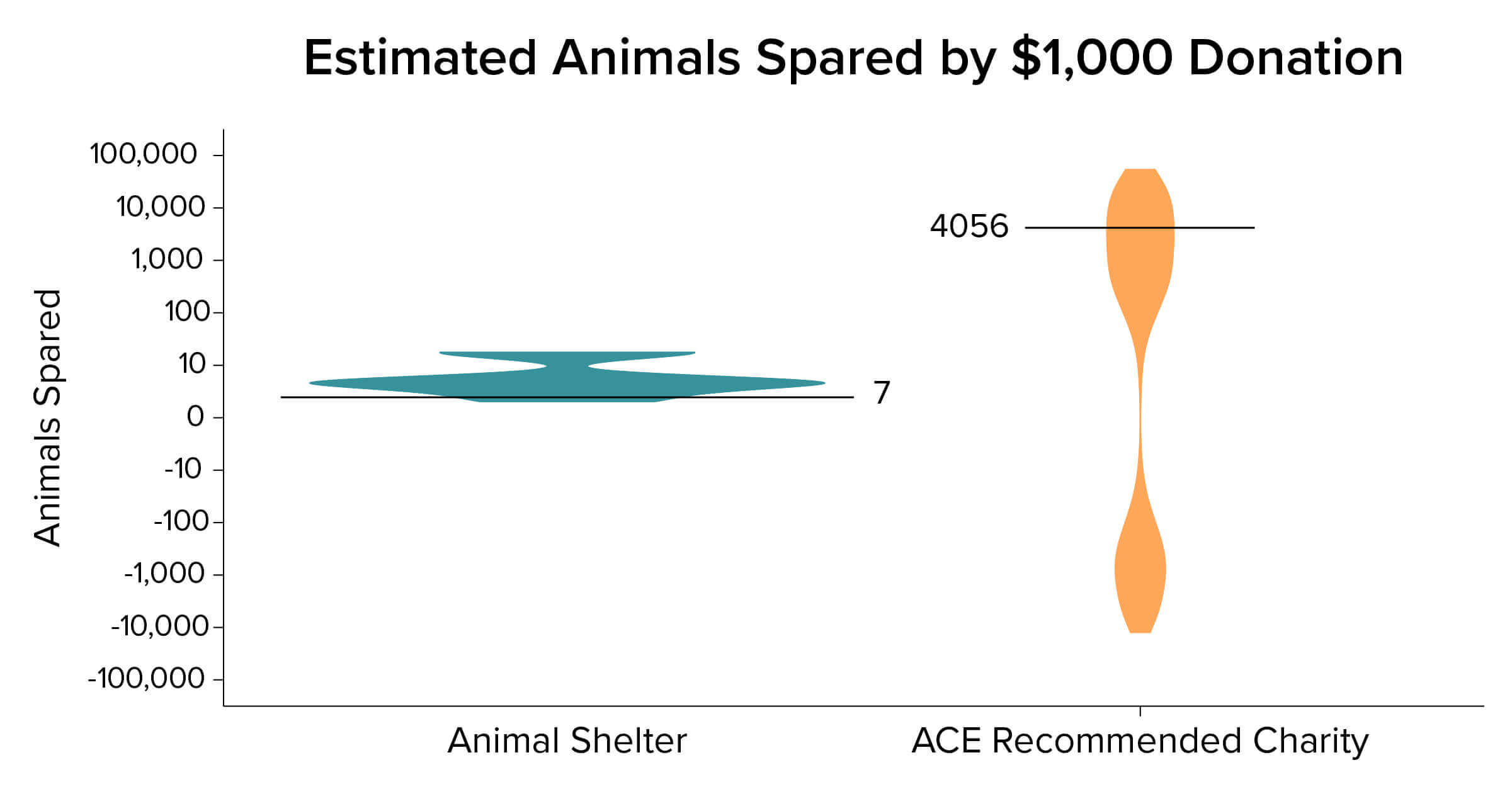
We’re currently in the process of improving some of our graphs in order to make them more easily shareable. For example, our donation impact page includes a violin plot that shows how many animals we estimate are spared by a $1,000 donation. While the data is accurate, the resulting graph is very difficult to interpret—and is therefore not ideal for sharing at animal rights conferences or on social or journalistic media. The amount of time it takes to explain probability density to passersby at non-EA conferences or to general online audiences looking for a quick picture that explains ACE’s thoughts usually exceeds their (understandably limited) attention span. If we want to reach these audiences, we need to produce graphs that illustrate the point much more efficiently.
However, sharing just the average estimates (seven animals spared for shelters and 4,056 for ACE recommended charities) could be seen as deceitful, as it doesn’t take into account the uncertainty involved in making these calculations.⁵ Clearly, there is some compromise between a full violin plot and sharing just the mean as the best single estimate for each category. We are still working out where that balance lies.
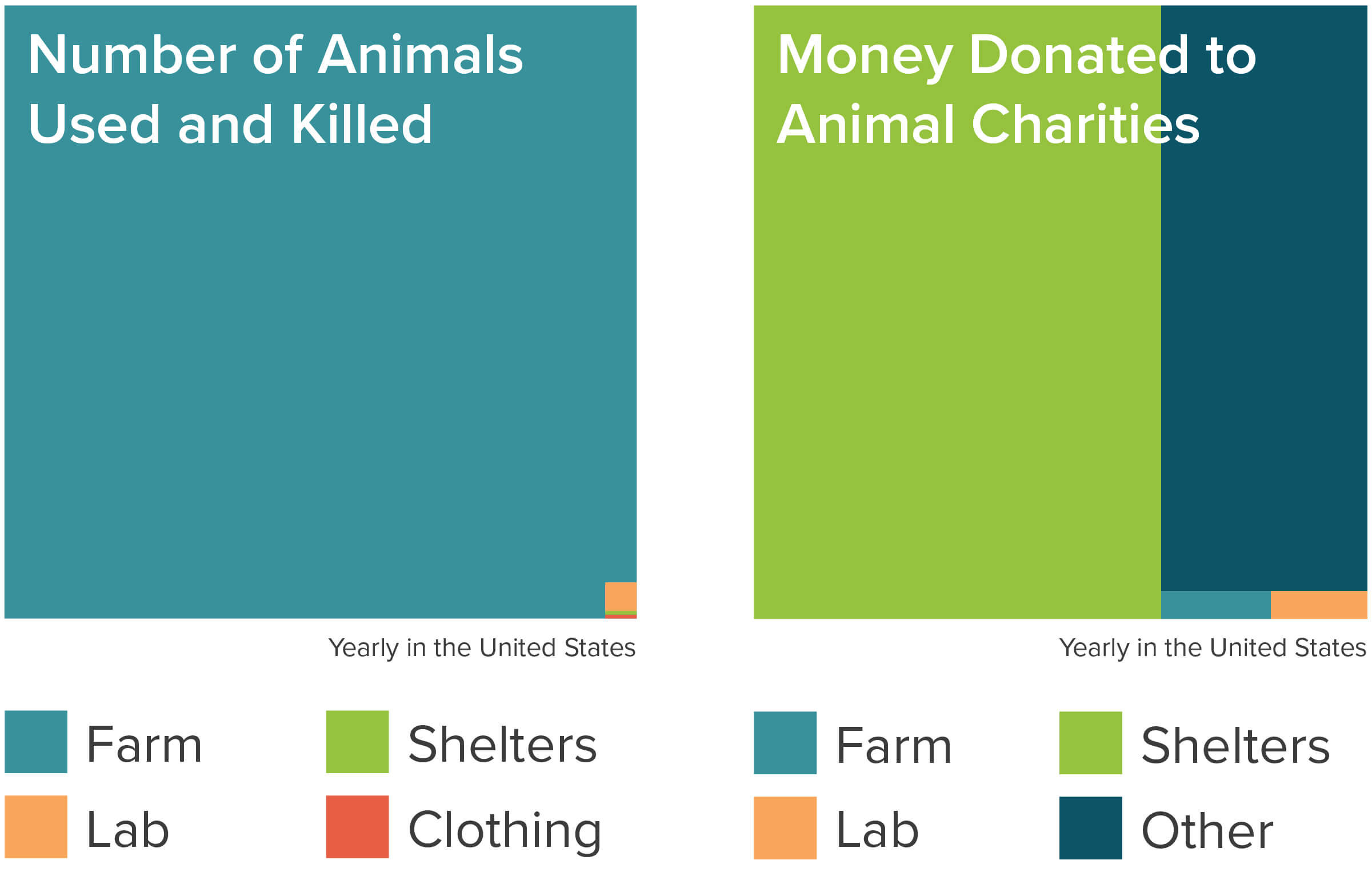
A similar issue comes up with our donation allocation chart.⁶ The data on the left omits wild fishes, who receive almost no portion of animal charity donations. The data on the left also includes animals used for clothing, but the data on the right replaces that category with “mixed or other activities.” On the page, we explicitly point out how the “mixed or other” category was put together, giving an example of guide dog training as one component. This matters because some advocates may consider subcategories like guide dog training as a primarily human-centric charity, not an animal charity, and this might affect the relative size of the chart regions. However, when this chart does gets shared online, it’s generally just the image portion that people will copy and paste. Although these shared images will not include the surrounding text, we believe it is sufficient to include the extra information on our website. We feel similarly with regard to the analogous donation impact chart; including the probability densities as additional information on our site is sufficient, so long as the chart itself includes ranges for our cost-effectiveness estimates.

Marketing Best Practices

The above marketing practices are specific to EA organizations. Most non-EA organizations do not object to setting up illusory donation-matching campaigns, nor reaching out based on fuzzies, nor ensuring that graphics are as accurate as possible. We care about these issues because we are committed to the norm of being extraordinarily honest.⁷ As Ben Hoffman rightly points out, “When the activity of extracting money from donors is abstracted away from…other core activities of an organization…, best practices tend towards distorting the truth.”
This doesn’t mean we should shy away from all nonprofit marketing best practices. To the extent that we can reach out to new audiences, increase the number of donors who are giving effectively, and grow our brand without compromising what we believe in, we feel that using best practices is both acceptable and desirable.
One of our goals is to continually be better able to introduce non-EA animal advocates to effective animal advocacy ideas. We accomplish this through several methods:
  • We try to speak in language that non-EA animal advocates already understand when in an appropriate context. This not only means using cute pictures in social media posts, but also talking about projects and interventions that may not be a currently understood top intervention, so long as it reasonably could apply.
  • We use multivariate testing on social media adverts and email campaigns, but we are careful to only test messaging that matches our brand and to only use subject lines that accurately convey the content of each email.
  • We segment our audience, showing different information to different audiences, while being careful not to cut information sent to various audiences in a way that might be seen as deceitful. Specifically, we take care to only show different content based on the different interests of our audience; we do not alter the meaning behind our messages when segmenting our audience.
  • We use a Google ad grant and SEO efforts to gain traffic from audiences not yet familiar with effective animal advocacy, without deceiving visitors as to what they will see once they visit.
  • We track key performance indicators to judge how effective our communications strategies perform, but are careful not to focus on quantity at the expense of quality.
  • We create videos that appeal to a general audience through fuzzies in addition to posting videos of webinars and symposium talks.
  • We take advantage of opportunities to direct more funding to effective animal charities, such as running a non-illusory matching campaign that is very likely to inspire new people to give effectively.
While we are careful not to blindly follow marketing best practices, we nevertheless utilize them when they don’t interfere with our values. We prize integrity and take care to exhibit norms of honesty when following accepted marketing principles. We do not use “rhetorical tricks” nor “sales techniques” to convince others; our use of imagery is solely used to gain attention. Arguments for EAA on our site are fully transparent, and we both accept and encourage feedback on the research we perform.
I’m proud to report that we are continuing to grow our brand, increase the number of donors who are giving effectively, and introduce new audiences to effective animal advocacy. In December last year, we raised over $1.26 million for our Recommended Charity Fund⁸—a significant portion of which came from extremely generous first-time donors not already identifying themselves as EAs. Of course, we couldn’t achieve these results for our recommended charities without the support of EAs, who so generously helped to fully fund ACE directly last year, but the larger point is that these strategies are encouraging non-EAAs to donate to more effective causes and are making a subset more aware of effective altruism in general.
If you work with an EA organization, we would love to hear about the marketing/communications techniques and/or successes that you’ve had when promoting EA organizations. We’d also like to hear if anyone has any concerns about ACE or any other EA charity using these kinds of marketing techniques. Are you comfortable with ACE’s methods of using donation-matching campaigns? Do you agree that marketing with fuzzies is acceptable even for a charity evaluator like ACE? What’s the minimal amount of information our shareable images should convey?⁹ Do you feel that the way ACE follows nonprofit marketing best practices is appropriate?
We look forward to hearing your thoughts.

¹ This donor decided to give to our Recommended Charity Fund on the basis of our recommendation, not by calculating the additional effects of the matching campaign, because they counterfactually would have done a different donation-matching campaign anyway. This means that while an overassignment of credit may have occurred, this overassignment did not change how the donor would have counterfactually acted. ↩
² In November 2017 we initially used the phrase “This means that you can double the impact of your donation from now through the end of the year by donating to our Recommended Charity Fund” in at least one marketing material, but after receiving feedback from both ACE staff members and outside EAs (including Remmelt Ellen and Marianne van der Werf—thank you to both!) we standardized to the “double your donation” language instead across all marketing materials.
In previous years we were less strict about our language, using “Double Your Impact” in several advertisements during the 2015 and 2016 giving seasons. We did not make this choice blindly; at the time, we felt that “double your impact” and “double your donation” were different mostly in what kinds of audiences they attract, and that this overrode any concerns about one being more strictly accurate than the other. “Double your impact” emphasizes the effect of helping others, whereas “double your donation” emphasizes what one can personally accomplish.
Note that these terms are regularly used interchangeably in fundraising campaigns outside the EA community, and we then felt that most people wouldn’t take campaign headlines literally. In 2017, we updated to believing that it was not enough for our FAQ to describe our commitment to non-illusory matching campaigns, and we standardized to only use “double your donation” language going forward. ↩
³ New donors made up 56% of the pre-matched amount raised during our 2017 matching campaign. ↩
⁴ This positive feedback loop means that the majority of our Facebook post views are of fuzzy-style content. However, this is only true for posts that get pushed out to users; for those who actively come to the ACE Facebook page for content, the ratio of fuzzy-style to utilon-style is roughly one-to-one. ↩
⁵ This is also explicitly why we do not publish cost-per-animal-spared numbers in the same way that you may see for QALYs or DALYs elsewhere. ↩
⁶ We acknowledge that there are limitations to this chart and are working on an updated version that will include both data on wild animal suffering and more clear proportions that indicate how limited animal charity donations are overall. ↩
⁷ ACE has publicly endorsed and acts in accordance with CEA’s guiding principles of effective altruism. ↩
⁸ In total, we influenced over $6 million to our recommended charities in 2017, including the $1.26 million that flowed through our Recommended Charity Fund. ↩
⁹ We are currently working on creating several more charts for non-EAs that are more shareable, and we would especially appreciate any remarks that express what level of simplification the EA community would be comfortable with. ↩

29 March, 2018

Influenced

Today, I participated in an art project which will be housed at the Brooklyn Art Library. I submitted a small amount of text to an artist who then drew the scene, bringing it to life. The piece is a book containing quotes, notes, and other such things by various people, each of which the artist, Katherine Hess, interpreted and illustrated within the confines of the sketchbook.

What follows is the text that I submitted to this art project:
Thirty years ago, my uncle rescued two people from a burning building. He’s not a firefighter, but he was in the right place at the right time. 
He became a hero that day. Although we don’t bring it up at family events, we know what he did, and we think better of him for it. He’s a hero because when he was put in a position to help, he did. I’d like to think that I would do the same. 
So when I learned about the effective altruism movement, that giving to the most effective charities could save a life just as real and just as important as those that my uncle saved, I decided to start giving a percentage of my income to effective altruism causes. 
For seven years, I’ve saved lives again and again. I don’t bring it up at family events, but I know what I do, and I think better of myself for it. I feel like a superhero, and it feels good. 
You, too, can feel this way. If you live in the developed world, you earn more than enough to donate and save lives every year. Visit effectivealtruism.org to learn more. 
Believe me: it’s worth the expense.

This and other sketchbooks by Katherine Hess are available at The Sketchbook Project. 

15 March, 2018

Animal Charity Evaluators Introduces the Recommended Charity Quiz

This entry was originally posted on Effective-Altruism.com. It is reposted here for reference only.


The following post was published on the Animal Charity Evaluators blog earlier this month. We've just released a new recommended charity quiz that allows users to enter in their specific preferences and outputs the best animal charities that correspond to those values. We believe that this is especially appropriate for effective animal advocacy charities, as there may be a higher level of variance depending on initial values than there would be with human-based charity comparisons.
When it comes to reaching out to non-EA audiences, we believe that using quizzes like this may allow us to connect more closely with existing animal advocates who are as-yet unfamiliar with EA ideas like focusing on just the "best" charity. We also want to be wary of relying too closely on expected value calculations, since the cost effectiveness estimates we use are approximations, fail to resolve uncertainty, and are subject to bias, even though we do think they are useful for intervention reports and charity evaluations. For these reasons, we believe that this new recommended charity quiz is both appropriate and useful.
The remainder of this post is copied verbatim from the ACE blog, authored by ACE Research Associate Jamie Spurgeon.

We are excited to announce the launch of our recommended charity quiz. This quiz will allow you to discover charities that match your interests and values, determined by some of the distinguishing features of our recommended charities.
At ACE we are always looking for new ways to engage with our community and help donors connect with the most effective charities. To this end, we recently released an update to our charity comparison chart and now you can use the quiz to receive a personalized recommendation of the three charities that best align with your goals and interests. While we think that reading our reviews is the best way to fully understand why we recommend our Top and Standout Charities, we recognize that reading all of our reviews may take more time than some readers have to invest. The charity quiz can help you to quickly identify charities that you may be particularly interested in, giving you more time to explore those organizations in depth.
The following information is for those more interested in further explanations of the factors explored in the quiz. In general, the quiz aims to capture individual preferences about charity features that aren’t clearly good or bad. By measuring the relative importance individuals place on each of these features, we can identify charities that closely align with those preferences.

How important is a strong track record of success?

This factor is directly related to Criterion 4 in our comprehensive charity review process. Among the charities we evaluate, there is a large disparity in the strength of their track records, and this is an important consideration for some donors. A charity’s track record encompasses at least three factors: (i) the length of time that the charity has been achieving successes, (ii) the number of successes they’ve achieved, and (iii) the magnitude of effect those successes have had in creating change for animals.
The quiz question aims to determine how important the overall effect of these factors are to you, relative to the other traits that make for a promising charity. If you are a potential donor, charities with strong track records may seem to be a safer option as they appear more likely to achieve future successes similar to those seen in the past. However, some donors may not feel that track record is necessarily a strong indicator of future success, or they may simply prefer to support younger charities that could be working in a particularly promising area in which it is possible they will have an even larger impact if successful.

Do you prefer to support more established advocacy methods with a lower risk of failure, or would you like to support advocacy that is less established but may have a potentially larger impact?

There are other aspects of charities’ work beyond track record that affect the balance between risk (the chance of future success), and reward (the magnitude of that success). If we recommend a charity that we perceive to be higher risk, then it is often because we feel their potential reward is higher, so these two individual factors tend to remain relatively in balance across all of our charities.
For example, a charity working in regions where the animal advocacy movement is less developed, such as parts of South America, may be considered higher risk but also higher reward. They may find several advantages to their work:
  • Wages may be lower, allowing them to achieve more with their budget
  • Proven methods from countries with more established animal advocacy movements can be re-used (e.g., using corporate outreach campaigns to secure cage-free commitments for egg laying hens)
  • Interventions such as investigations may have a higher impact, as they are less saturated in number1
However, there are unknown factors involved with work in some South American countries that may make it less tractable than it initially appears:
  • The public attitudes towards vegan advocacy may be less favorable, or other unknown cultural differences may affect individuals’ receptivity to advocacy messaging
  • The different legal situation may prohibit the success of some interventions (such as investigations and corporate outreach)
  • The political climate may affect the likelihood that legal advocacy work will be successful
Other examples of charities that might be considered higher risk/higher reward include charities that work on longer-term goals and those that are focusing efforts on highly neglected groups of animals (such as fish). This quiz question aims to capture each donor’s preference for higher vs lower risk/reward.

Do you prefer to donate to charities with smaller budgets, or larger budgets?

During our charity evaluations, we have two main criteria in which we consider a charity’s budget—Criterion 1, which concerns the amount of room for more funding that a charity has, and Criterion 3, which concerns the cost effectiveness of the charity’s programs. As it is objectively better for a charity to have both a higher room for more funding and a higher cost effectiveness, these are not especially useful metrics for determining a preference that our audience may have. However, the absolute size of a charity’s budget often comes with advantages and disadvantages, and the charities we recommend span a large range in this regard. For example, donations to smaller charities will have a greater effect on that charity than a similar donation to a charity with a much larger budget. Additionally, smaller charities are more likely to be working in novel areas. On the other hand, charities that have a larger budget may be able to achieve things that smaller charities can’t, such as influencing large food producers in a corporate outreach campaign.

How important is it for a charity’s work to support the animal advocacy movement as a whole?

While most of our recommended charities work to directly cause change for animals, there are some that also (or sometimes solely) work to support the movement as a whole. This includes conducting and publishing research, either in collaboration with other charities or through evaluating their own programs. It also includes charities that take on a more organizational role, providing support to and helping coordinate the efforts of other charities in order to create a greater impact. Charities that are not as supportive of the movement, however, may be less so because they are working in particularly niche or neglected areas, and this may be of particular interest to some donors. Some donors may also simply prefer to support charities that work more directly to create change for animals.

Which types of animal advocacy do you want to support?

To measure donors’ preferences for particular interventions, we have divided up the types of animal advocacy interventions into three main groups: traditional advocacy, institutional advocacy, and innovative advocacy.2 Traditional advocacy includes interventions that have been commonly used by the movement for more than 10 years and often aim to create individual changes in attitudes or behavior—such as the adoption of veganism. These interventions include leafleting, protesting, and undercover investigations, among many others. Institutional advocacy includes any interventions that target institutions—from large international corporate food producers to smaller institutions such as schools and hospitals. Finally, innovative advocacy encompasses more novel areas of advocacy—including the development of cultured and plant-based meat, securing legal rights for animals, and conducting or facilitating research into wild animal suffering. These tend to be more ambitious approaches that have large potential for change, but that also have more uncertainty surrounding whether their end goals will be achieved.

Putting it all together

We have given each of our recommended charities featured in the quiz a subjective score for each topic that is covered by a question or a particular response. As you go through and specify your preferences, the quiz uses your responses to weight the scores given to each charity. It then recommends the three charities that most closely align with the preferences you indicated. Expressing a strong preference for a particular question puts a higher weight on that factor when calculating your matches.
If you have any further questions, please leave a comment here or submit a feedback form at the end of the quiz. Don’t forget to share your results!

  1. We expect that the U.S. is reaching a point where the large number of investigations released means that future investigations are likely to start to have diminishing returns. 
  2. It’s difficult to divide interventions into distinct categories, as often those categories will overlap. For example, while protesting and undercover investigations are examples of established advocacy interventions, they are both also used to support institutional campaigns. However, as multiple answers can be selected for this question, we hope this won’t significantly skew our quiz results. 

30 November, 2017

[LINK] AMA by Animal Charity Evaluators on Reddit

This entry was originally posted on Effective-Altruism.com. It is reposted here for reference only.

Animal Charity Evaluators is currently doing an Ask Me Anything session on the /r/vegan subreddit. If you have any questions about ACE's 2017 charity recommendations, this would be an ideal place to directly ask the researchers at ACE.

Even if you come across this link after the AMA concludes, you may find the discussion there useful.

07 September, 2015

A Defense of Normality

This entry was originally posted on Effective-Altruism.com. It is reposted here for reference only.

At EA Global, I met many different kinds of people. Some were gung-ho about EA, claiming that effective altruism meant that we should spend all our money on EA charities, to the detriment of artistic culture, movies, music, and even maintaining museums. Others seemed to only be concerned with certain subsets of EA, like those who care only about the charity recommendations. One person I met at EA Global claimed that he uses EA to determine where to send his 10% pledge to, but that’s the extent of his EA actions. He considers himself an EA, and rightly so, I think; after all, he is one of the most important parts of this community, and I’ll explain why later in this post.

There are those who claim that you’re not a true EA unless you really push hard on all the EA principles. I’ve never heard anyone claim that you have to be perfect, but I have heard people say that you need to give more than just 10%, that you’re not really EA if you give to non-EA charities, that if you spend more than a few dollars on things like video games, then you can’t really call yourself an EA. (These are not made-up accusations. I really have encountered people saying these things.)

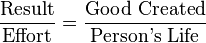
I get where these people are coming from. They’re trying to maximize the output of good from their one life. And this makes sense. After all, effectiveness is all about getting the largest quotient of result over effort. We want the most results per effort given. For most people in the effective altruism community, this translates to accomplishing the most good per dollar. EAs focus on ensuring that our money goes to charities instead of sailboats (hence the GWWC pledge) and that, of the money sent to charity, that money goes to the right places (hence GW/ACE-style charity recommendations). These interpretations make sense to me.

But the people who claim you need to do even more if you want to be a true EA are interpreting the effectiveness quotient somewhat differently:

Result / Effort = Good Created / Person’s Life

They reason that effective altruism is all about creating the most good per life lived. In their interpretation, each of us has to maximize the good we produce throughout our lifetimes. For some, that would be through direct charity work, for others, it’s a giving pledge, and for still others it might be building wealth to be allocated once they die.

These people are laudable. I’m not going to say that they are doing badly by making this choice with their life. But I am going to claim that these actions are supererogatory.

Ultimately, I think these people are using the wrong reference class. They’ve plugged in incorrect numbers into the quotient, and are missing what’s really important. I believe the quotient should instead be interpreted as:

Result / Effort = Good Created / Marketable Individual Sustainable Effort

My claim is that the divisor should not be the full life of an individual EA, but instead each marketable and sustainable effort that is put in by each individual EA. This is a little convoluted, so I’ll explain.

As a first approximation, consider the divisor to be Individual Effort. This would mean that we’d need to do the most good for each effort we make. Whatever we expend energy on should have “most good created” as its ultimate purpose (in the sense of telos). But following this rule would lead to very short lives, as expending effort to eat food probably doesn’t maximize the possible good one could do in the present. This approximation just doesn’t consider the number of future moments of effort that are also possible to do good.

So we then go to a second divisor approximation: Individual Sustainable Effort. Now we can try to make each effort we expend have “most good created” as the telos, so long as that effort, in combination with other efforts, is sustainable. This approximation lets us eat food, sleep, and have recreation, as it recognizes that we need those things in order to continue doing good throughout the remainder of our lives. By this approximation, we should expend whatever minimal amount of time/money we spend on eating/sleeping that is possible. But this is missing something crucial: actually doing this would make our lives miserable. Sure, if it made it too miserable, we’d stop being EAs -- so this principle would give us the minimal comfort necessary to allow us to continue doing good until we die (or indefinitely, depending on your stance on life extension). But we wouldn’t be happy about it. (If you don’t think that some EAs think this way, consider the fact that Julia Wise actually had to argue that having a child was compatible with effective altruism.)

That’s where we get the next divisor approximation: Marketable Individual Sustainable Effort. Here we finally recognize that the good we do isn’t just based on the good we do directly, but also the good we do indirectly by helping others become EAs as well. The minimal comfort level we need is not the level at which we can continue to do direct efforts indefinitely, but instead the level at which we can successfully market the EA mindset to others so that they can accomplish good as well. In other words, we shouldn’t just get enough sleep to survive for another day of grueling EA work, we should get whatever threshold of sleep will allow us to both live a good life of comfort and pleasure, while maintaining the EA work we do.

Ensuring that things are marketable isn’t sexy (even though marketing those things usually is), but it’s an important component of the good each of us can accomplish. We are still at the beginning stages of our movement, though it is indeed growing quickly, and we need to be aware of how our choices of what is and is not a norm in this group can affect whether others decide to join the movement.

Giving What We Can had it right when they chose to make the pledge 10%. That number has historical familiarity with a western audience and doesn’t seem to be too much for a modest-income individual to give. This allows it to be marketable. Even if some EAs give much more, the main point here is that the norm should be a lower percentage like 10%. The Life You Can Save advocates for a looser standard for those with less income, and a higher standard for those with more income. Their suggestion is to give more than 10% if you make over $500k each year, and less than 10% if you make less. Their reasoning is that when it comes to lower-income people, the most important thing is volume; when it comes to higher-income people, the most important thing is magnitude.

Standard-lowering to lower the barrier of entry is important to those of us who market effective altruism to the mass audience. EAs who give more than 10% are awesome, but in order for this movement to spread more generally, we need more people at the 10% level. I’m not saying anyone should lower their pledge -- but I am saying that we should be inclusive of new EAs who come in only at that pledge level and stay there.

The above paragraph should be offensive to no one. I have high confidence that everyone reading it said to themselves: yeah, that’s obvious. But when I make the same claim about sleeping, eating, or playing video games, that’s when I seem to get pushback.

EAs who get by on less than eight hours of sleep through polyphasic hacks are laudable. You guys have so much more time available to you with which you may accomplish good. But in order for the movement to spread more generally, we need the norm to be more like eight hours of sleep.

Those of you who spend less time on cooking by eating those powder meals are impressive. You spend so much less time and money on food that you have the ability to spend that money/time on more important things, like doing good. But in order for the movement to spread more generally, we need the norm to be something more like three meals a day, or at least eating when hungry, and taking the time to cook good meals, simply because eating well is a pleasure that most humans would not want to do without.

Those of you who don’t play video games, who don’t go out to the movies, who don’t play CCGs -- you guys are great. By not expending so much time and energy on recreation, you can do much more good. But in order for the movement to succeed, we need the norm to include EAs having fun. Not just fun on the fringes, but EAs spending real money and time on whatever recreational things they like to do.

Effective altruism should be about creating the most good per marketable individual sustainable effort. We can’t go too far on the marketable side, because then it isn’t sustainable. We can’t go too far on the sustainable side, or it won’t be effort. Each of these adjectives reigns in the rest in a way that allows our movement as a whole to accomplish the most good. (At least this is true in the near term, where most individuals are non-EAs. Once a certain threshold of people are EAs, the marketable aspect ceases to be as important, at which point maybe something else comes into play, like maximizing the happiness of that large EA group.)

The best way to accomplish the most good is probably(?) to get very rich people/nations to give their money differently and more often. But most of us can’t work on that kind of project, because we don’t have access/influence on those people/nations. However, we can work on the second best way to accomplish good: growing the movement so that each of our effects are multiplied. Our individual efforts are great, but that extra 25% of time you get from cutting your sleeping hours in half could be replicated four-fold by just recruiting another person into effective altruism. If sleep reduction were the norm in EA circles, it would be much more difficult to recruit new EAs. (This doesn’t mean that you should cease polyphasic sleep; it just means that polyphasic sleep is supererogatory to EA.)

I realize that the absurdity heuristic comes into play here. Just because powder-eating and polyphasic sleeping sound silly doesn’t mean that we should reject them. Sometimes it is important to ignore our silliness heuristic and instead shut up and multiply. But we can only convince X people to do those things that seem silly, which only creates f(x) utility. Whereas we can instead downplay the silly-sounding stuff as an EA cultural norm, and instead recruit Y people to EA, which creates g(y) utility. My claim is that g(y) > f(x), so we should focus on ensuring EA norms are marketable. This doesn’t mean that individual EAs shouldn’t try to be even more effective -- it just means that it shouldn’t be perceived as a norm among the community.

And now, a confession. I sleep a lot. I average around nine hours, but with a large variance each night. I like to eat well. I spend a lot to get the specific foods I like best, and I eat out more often than most people I know. I don’t skimp on my playing budget. I play a lot of videos games -- on consoles, handhelds, computers, and mobile; I even co-host a video games podcast. I play board games regularly with a local playgroup, and I’m almost always the one purchasing the games. I enjoy books. My house is filled with books, to the point where you might call every room except the kitchen a library room. Though probably this is more due to my housemate than to myself specifically.

I do all these things because these things make my life enjoyable. These expenses of time and money are not cheap, but they help me to enjoy life not just to the point of sustainability, but beyond to the point of marketability.

So do I count as an effective altruist, even though I spend so much time and money on sleeping, eating, and various forms of recreation? I’d like to think so. I give 25% of my income each year, and I have for two years at this point. I have volunteered at three different EA organizations, and have worked at one for two years. I attended EA Global this year; I participate regularly in online discussion groups; I’ve gone to a few local EA meetups. Maybe I have a poor prior, but I think most of you will consider me to be a full-fledged EA, not just a fringe EA.

Given that, I think that more of us who spend a lot of time on sleep, food, and recreation (even if it’s stuff like M:tG, WoW, clubbing, scuba diving, etc.) should speak up and say that that’s how we are living our lives. Right now, when people look through the facebook posts of well-known effective altruists, they see stuff like eating powder, sleeping less, and always-working-toward-the-cause. While I’m not making the claim that what these people are doing isn’t morally praiseworthy, I am making the claim that those of us who don’t do those things should speak up more often so that the norm of EA is perceived as fun-loving 8-hour sleepers who enjoy the taste of food often.

We shouldn’t just spread a meme of giving to the best charities, or of giving 10% of income. We need to spread the meme of effective altruism itself, and that requires more of us to be vocal about just being regular people. Without approachable EA norms, growing our movement will be limited to those willing to do supererogatory acts.

26 August, 2015

Animal Advocacy at EA Global

This entry was originally posted on the AnimalCharityEvaluators.org blog. It is reposted here for reference only.

Recently, I went to EA Global at Google HQ; it was the first of three EA Global conferences held across the world, the last of which is taking place this weekend at Oxford University.

EA Global is all about effective altruism, the movement upon which Animal Charity Evaluators was originally founded. Effective altruists use evidence and reason to determine the best ways to improve our world, including causes as varied as poverty reduction, global health improvements, existential risk mitigation, and, of course, reducing animal suffering.


Not everyone at the conference was working on animal advocacy, but it was well represented by both speakers and attendees. Several people at the conference had lively discussions on the merits of helping animals as compared to other high-value impact opportunities. Many attendees have dedicated their lives to effectively making the world the best it can be, and quite a few of them ended up deciding that the best way to do this was to help animals. A full third of EAs are veg*n, and many EAs consider animal advocacy to be a major pillar of the EA movement.

Among fellow animal advocates, it’s rare to see arguments about where animal suffering ranks among competing causes. Generally animal advocates already agree that saving animals now is the priority, and so discussion is less philosophical and more action-oriented. But at EA Global, everyone was waxing philosophical on animal issues.

In his talk, Jeff Sebo pointed out that if we value future animals similarly to animals living in the present, then future non-human animals might very well be the top priority, since we have every reason to expect that they will outnumber humans by several orders of magnitude on into the future. This is especially true if we terraform planets, since plant-only ecosystems aren’t possible without extensive robotic interventions. For an idea of just how mind-bogglingly big these numbers can get, listen to Nick Bostrom’s talk on astronomical stakes.

Andrew Critch made the excellent observation that human existential risk is especially important for animal welfare, since if humans go extinct, then we can expect wild animal suffering to continue for another 4 billion years or so. If one’s goal is to minimize animal suffering, one plausible method might be to ensure that humans don’t go extinct, since nature isn’t likely to give us a second shot at creating a species that shares our morality.

Nick Cooney highlighted an amazing statistic of 2 cents per animal spared by using corporate outreach, and claimed that the cost per animal spared would go even lower by reusing the same techniques with other companies. This statistic was repeated several times during the conference, usually with skepticism on how it could possibly be that cheap. For reference, ACE’s latest estimate is $0.21 per animal spared, which is still much cheaper than human causes.

Several EA Global attendees expressed concern about the level of evidence the animal advocacy community has so far compiled on which interventions work best. This criticism is one that we should take seriously, and thankfully we have people in the community working on this issue right now. This is the true power that the effective altruism community brings to the animal advocacy movement: a level of scientific and philosophical rigor aimed toward ensuring we accomplish the most good as effectively as possible, alongside the funding to back it up.

It’s time for the greater animal advocacy community to learn more about effective altruism. The final leg of EA Global is happening in Oxford this weekend (August 28-30), but you don’t have to travel to England to be a part of event. There are EAGx events happening across the globe where you can meet up with local EAs and experience the online version of the conference in a group setting, or you can check out the livestream to live out the conference from the comfort of your home.

Take the time to see what EA Global has to offer, since it not only has the capacity to grow the animal welfare movement by bringing in newcomers to the cause, but also to help us identify ways that we can improve how we approach our goal of reducing animal suffering. Plus, you might learn a little bit more about how we can best improve our world among other cause areas.


Animal Advocacy | EA Global Conference - August 1, 2015 from CyperusMedia.com on Vimeo. Jacy Anthis, Jeff Sebo, and Nick Cooney talk animal advocacy at EA Global: Google HQ.