09 October, 2012

My Sense of Ethics

Perhaps the most interesting conversation I have when meeting new people is when they start to ask me about my ethical views. It generally comes up pretty early on when I meet people, as so many of the things that set me apart have a basis in my morality. I don't do this on purpose; it just naturally turns out this way.

I'm vegetarian (largely vegan), so if they happen to see me when I'm eating or otherwise ordering food, this is an early entry point into the ethics discussion. But far more often are the oft-asked questions: "what do you do?" or "what are you into?", both of which go straight into a description of optimal philanthropy. In either case, it isn't long before they start asking me why I speak so strangely when it comes to ethical issues.

If you haven't had the ethics conversation with me in person (or if you knew me before I fully fleshed out my views), then it would help to explain what I'm talking about. A typical exchange might go something like this:

New acquaintance: "So what kind of stuff are you into?"

Eric: "My main interest at the moment is in optimal philanthropy. I strongly prefer a world where charitable contributions get distributed rationally, so I do what I can to try and help determine which organizations have aims that make sense."

New acquaintance: "Oh, I get it. So you're into figuring out which charities are better than others. I've heard of that."

Eric: "I wouldn't put it exactly like that, but yes, I think you have the basic idea."

New acquaintance: "How would you put it?"

Eric: "I just wouldn't use the word 'better'; that's all. I mean, obviously some charities are indeed better at accomplishing their goals, but that doesn't make them better in the moral sense of the word."

New acquaintance: "Surely if they're better at accomplishing Good, then they're better morally speaking."

Eric: "For moral realists, yes; but I'm not a moral realist."

And this is where the vast majority of people will try to find a polite way of ending the conversation.

My moral anti-realism stance has caused countless numbers of otherwise rational competent people to think I'm nuts. To many educated (but not philosophical) people, moral anti-realism is just code for nihilism. Hell, even among anti-realist philosophers, the specter of nihilism informs many of their arguments. (Mackie, Blackburn, Timmons, Joyce, and even Rawls all endorse moral anti-realism while doing their damnedest to be dishonest about it, just to stay as far away from nihilism as they can.) So I guess it's understandable if the average new acquaintance I make will also make the same mistake.


Review: Robots and Empire

Robots and Empire Robots and Empire by Isaac Asimov
My rating: 5 of 5 stars

The action really starts to heat up in this entrant to Asimov's epic series of scifi novels. Daneel Olivaw and Giskard Reventlov make up one of the most interesting teams you'll find in any scifi story. This is one of my favorites in the Robot series, and is definitely worth an extra slow read.

If you're new to Asimov, don't start reading here! Start at the beginning of his Robot series; otherwise, you'll regret reading them out of order.

View all my reviews

08 October, 2012

Review: The Sword of Good

The Sword of Good The Sword of Good by Eliezer Yudkowsky
My rating: 5 of 5 stars

A fantasy enthusiast from our world is transported to a world of fantasy, wielding the Sword of Good. Dolf the wizard and Selena the pirate join him on his quest to confront the Lord of Dark.

More cannot be said without giving away the storyline, but rest assured that this is an excellent read for any fan of the fantasy trope.

I most definitely recommend this short story.

View all my reviews

06 October, 2012

Review: Three Worlds Collide

Three Worlds Collide Three Worlds Collide by Eliezer Yudkowsky
My rating: 5 of 5 stars

This short story describes a spaceship of humans in the future who make first contact with not one, but two intelligent alien races. The result involves spirited debate as each of the three realize they all have very different views on which moral facts are true.

If you have a group of friends interested in metaethics, I strongly recommend you try printing out hard copies of this short story in sections, and read the story together in person. Each successive section will give you a lot to talk about, and there are few enough sections of short lengths that it will only take around 2.5 hours to read through every section with plenty of conversation between each.

Those not as interested in metaethics will still get something out of the story, though they might not rate it as highly as I have.

View all my reviews

05 October, 2012

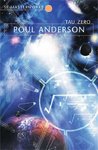
Review: Tau Zero

Tau Zero Tau Zero by Poul Anderson
My rating: 5 of 5 stars

Fifty colonists embark on a ten year subjective voyage at relativistic speed to a new world, but tragedy strikes unexpectedly, and the crew must deal with the consequences. What follows is an amazing story of emotion, suspense, and scientific action. Poul Anderson does a superb job both with developing the character relations and pushing the crew through a remarkable (yet plausible*) plot. This cook is a bellweather of the hard science fiction genre, and should be on the to-read list of any true hard scifi fan.

Now that I've given my five star recommendation, if you haven't read the book yet, stop reading this review here. Spoilers are ahead.

While this book is definitely some of the hardest of the hard science fiction that there is, it follows through scientific theories that have since been disproved. As most science enthusiasts today know, the universe is not an oscillation type; due to dark energy, the universe will instead expand forever, making the premise of the final chapters of the book an implausible solution. Interestingly, Bussard drives (or something similar to it) in our distant future might potentially be used to try and extend how long we can last before heat death eventually takes over. In such end times, using technology to amass mass (if you'll excuse the lame pun) will be necessary if we ever plan on creating new stars out of the void.

Second, I feel conflicted on how Anderson dealt with the relationships among the crew. I'm not saying it wasn't somewhat realistic, but with only 50 members, a polyamorous lifestyle should have really been assumed from the start. Granted, Anderson arrived there eventually once it was realized that they could expect no further colonists to come along, but it bothered me early on in the story that they did not arrive to such a conclusion earlier. I suppose in Anderson's future world, polyamory is as looked down upon as it was in the time this book was first written.

Third, the final moments of this novel seemed a bit rushed for me. Refusal of kingship, mandate to make this part of the universe human-centric, and a switch to polyamory were all introduced in a matter of paragraphs, followed only by an abrupt ending. While I realize that there's not much story left that can be told while remaining truly hard scifi, I nevertheless felt sad at realizing the story would not continue. But perhaps I am too enamored with long-running series.

View all my reviews